Navigate

Where to?
Pick your path.

AI Agent Development Course in India

A live, mentor-led AI agent development course for developers, AI engineers and automation professionals — build multi-agent systems with LangGraph, CrewAI and AutoGen, and ship them to production.

01
100% Live Instructor-Led Classes
02
4 or 6 Months (Weekday / Weekend)
03
Build 9 Production AI Agents
04
LangGraph, CrewAI, AutoGen, MCP
Agentic AI developer course by Skillfyme — building multi-agent systems with LangGraph, CrewAI and AutoGen
16 WeeksAgentic AI Track
9Agents You Build
4Agent Frameworks
100%Live Sessions

AI Agent Development Syllabus

Sixteen weeks from first principles to a deployed multi-agent system. Every module is hands-on — you build, break and ship agents rather than watch them being demonstrated.

  • What separates an agent from a chatbot: autonomy, goals and feedback loops
  • The perceive → reason → act → observe cycle
  • Agent architectures: ReAct, Plan-and-Execute, Reflexion
  • When an agent is the wrong tool — cost, latency and reliability trade-offs

24+ Agentic AI Skills Covered

Every competency mapped to what teams hiring agent engineers in India actually test for in interviews.

Agent Engineering

  • Agentic AI Systems
  • ReAct & Plan-and-Execute
  • Tool Use & Function Calling
  • Workflow Orchestration
  • Multi-Agent Coordination
  • Human-in-the-Loop Design

Retrieval & Context

  • RAG Architecture
  • Vector Retrieval
  • Embedding Strategy
  • Hybrid Search
  • Agent Memory Design
  • Context Window Management
Mapped to real agent-engineering job descriptions24 Competencies →

The Agentic AI Stack You’ll Ship With

Every tool chosen for real-world relevance — the same stack that powers production AI at product companies hiring agent engineers.

Tech Stack · Agentic AI Track

Programming & Data

The Python foundation every agent is built on.
PythonPandasNumPyPydanticJupyterGit
Industry-Standard · Production-Grade37+ Tools →
  • Programming & Data: Python, Pandas, NumPy, Pydantic, Jupyter, Git. The Python foundation every agent is built on.
  • LLM Foundations: OpenAI API, Anthropic API, Hugging Face, Ollama, Transformers. Working with frontier and open-weight models.
  • Prompt & Context: Prompt Engineering, JSON Mode, Function Calling, Few-Shot Design. Getting reliable, structured behaviour out of a model.
  • RAG & Vector DBs: FAISS, Pinecone, Weaviate, Chroma, Milvus. Grounding agents in real, retrievable data.
  • Agent Frameworks: LangChain, LangGraph, LlamaIndex, Phidata. The core orchestration layer for single agents.
  • Multi-Agent Systems: CrewAI, AutoGen, MCP, Agent Protocols. Agent teams that delegate, debate and converge.
  • Evaluation & Tracing: LangSmith, LangFuse, LLM-as-Judge, Pytest. Making a non-deterministic system measurable.
  • Deploy & Agent Ops: FastAPI, Docker, AWS, CI/CD, MLflow. Shipping agents and keeping them alive in production.

Build Agents That Actually Ship

Real agent engineering in real production environments — from a single-tool agent to an autonomous multi-agent system under guardrails.

Select difficulty level
FoundationBuild core agent intuition through hands-on implementation3 Projects
Tool Use & Function Calling

Single-Tool Research Agent

Build an agent that decides when to call a web-search tool, reads the results and returns a cited answer instead of hallucinating one.

WorkflowTool Schema Design → Function Calling → Result Parsing → Citation Output
Stack
PythonLangChainOpenAITavily
Retrieval-Augmented Generation

Document Q&A with RAG

Ingest a document corpus, chunk and embed it, then answer grounded questions with citations and an explicit refusal when context is missing.

WorkflowChunking Strategy → Embedding Generation → Vector Search → Grounded Answering
Stack
LangChainFAISSChromaOpenAI
Schema-Constrained Output

Structured Data Extractor

Turn unstructured documents into validated JSON using structured output modes, with retry logic when the model returns malformed data.

WorkflowPydantic Schemas → JSON Mode → Validation Loop → Error Recovery
Stack
PythonPydanticLangChainAnthropic

Ready to start building agents?

Get expert guidance and mentorship on every project, from engineers who ship production AI.

What You’ll Learn Building Agents

Nine structured objectives from agent foundations to production agent ops — select any node to explore it.

Learning Roadmap · Select to Explore
01

Agent Foundations & Architectures

Core

Understand what separates an agent from a chatbot: autonomy, goal-seeking, feedback loops, and the ReAct, Plan-and-Execute and Reflexion patterns.

Objective 01 of 099 Learning Objectives →
  • 01. Agent Foundations & Architectures — Understand what separates an agent from a chatbot: autonomy, goal-seeking, feedback loops, and the ReAct, Plan-and-Execute and Reflexion patterns.
  • 02. LLM Foundations for Agents — Prompt engineering for reliable tool selection, structured output and JSON mode, context-window budgeting and model selection under cost constraints.
  • 03. Tool Use & Function Calling — Design tool schemas an LLM uses correctly, wire API, database and code-execution tools, and standardise them with Model Context Protocol (MCP).
  • 04. RAG & Vector Retrieval — Ground agent responses in real data with chunking, embeddings and hybrid search across FAISS, Pinecone, Weaviate and Chroma.
  • 05. Agent Memory Systems — Give agents short-term, long-term and episodic memory, with summarisation strategies that keep long histories inside the context window.
  • 06. LangChain & LangGraph — Compose agents with LangChain primitives, then model them as LangGraph state machines with cycles, branching and human-in-the-loop checkpoints.
  • 07. Multi-Agent Orchestration — Build agent teams with CrewAI and AutoGen using supervisor, hierarchical and swarm topologies, with delegation and conflict resolution.
  • 08. Evaluation, Guardrails & Safety — Evaluate non-deterministic systems with LLM-as-judge and trace scoring in LangSmith and LangFuse, and defend against prompt injection and tool abuse.
  • 09. Deployment & Agent Ops — Serve agents behind FastAPI, containerise with Docker, and run CI/CD with prompt versioning, cost caps and production monitoring.
Grow With Skillfyme

Grow With Skillfyme.

Five phases. One transformation — from your first agent to a placed career in AI engineering.

Foundation

Start with clarity and direction.

  • Understand what agent engineering roles actually require
  • Identify the right role for your experience and market demand
  • Align your learning path with hiring needs in India
  • Phase 01: Role & Career Alignment — Start with clarity and direction. Understand what agent engineering roles actually require. Identify the right role for your experience and market demand. Align your learning path with hiring needs in India.
  • Phase 02: Resume & LinkedIn Preparation — Build a strong professional presence. Tailor resumes to AI and agent engineering job roles. Optimise with the framework keywords recruiters screen for. Improve LinkedIn visibility with projects and case studies.
  • Phase 03: Agent Portfolio & GitHub — Prove your skills with shipped agents. Publish every agent project as a documented repository. Link deployed demos to your resume and LinkedIn. Show working systems, not notebooks.
  • Phase 04: Mock Interviews & Skill Development — Get interview-ready with confidence. Technical mocks on agent design and system trade-offs. Improve communication and system-design articulation. Role-based mocks aligned to real job descriptions.
  • Phase 05: Job Interviews & Opportunities — Convert preparation into offers. Get referred to open AI engineering roles. Connect with hiring partner companies. Apply through job portals with interview support.

Agentic AI Use Cases in the Real World

Where autonomous agents are actually deployed today — and the capability each pattern depends on.

Software Engineering

Autonomous Code Review Agents

Agents that read a diff, run the test suite, flag regressions and open a PR comment with a suggested patch — escalating to a human when confidence is low.

Tool use · Code execution · Guardrails

Customer Support

Tier-1 Resolution & Triage

Retrieval over policy documents and ticket history to draft grounded replies, auto-resolve routine issues and route the rest with full context attached.

RAG · Classification · Escalation logic

Financial Services

Research & Compliance Analysis

Multi-agent crews that gather filings, cross-check figures against source documents and produce cited summaries an analyst can audit line by line.

Multi-agent · Citation tracking

Healthcare Operations

Clinical Documentation Support

Agents that structure unstructured notes into validated schemas, with human-in-the-loop approval gates before anything enters a record system.

Structured output · Approval gates

E-Commerce

Catalogue & Merchandising Agents

Automated product enrichment, category assignment and description generation across large catalogues, with quality scoring before publication.

Batch pipelines · Evaluation

Internal Operations

Enterprise Knowledge Assistants

Agents that search across wikis, tickets and databases to answer employee questions, honouring per-user access permissions at retrieval time.

Hybrid search · Access control

AI Agent Development Course Fees in India

₹50,000₹68,000
Save 26%

Or ₹4,167/month for 12 months on EMI.

Next batch: 20th September 2026 · Seats filling fast

What’s Included

  • Full GenAI With ML Masters Program access
  • Complete agentic AI module track
  • 9 deployed portfolio projects
  • Live mentorship & doubt-clearing
  • Session recordings for every class
  • Placement support & mock interviews

Part of the GenAI With ML Masters Program

This agentic AI track is delivered inside Skillfyme’s flagship generative AI and agentic AI course, alongside the LLM, RAG and MLOps foundations that production agents depend on.

View Full Program

About Vishlesan i-Hub, IIT Patna

Who stands behind your certificate.

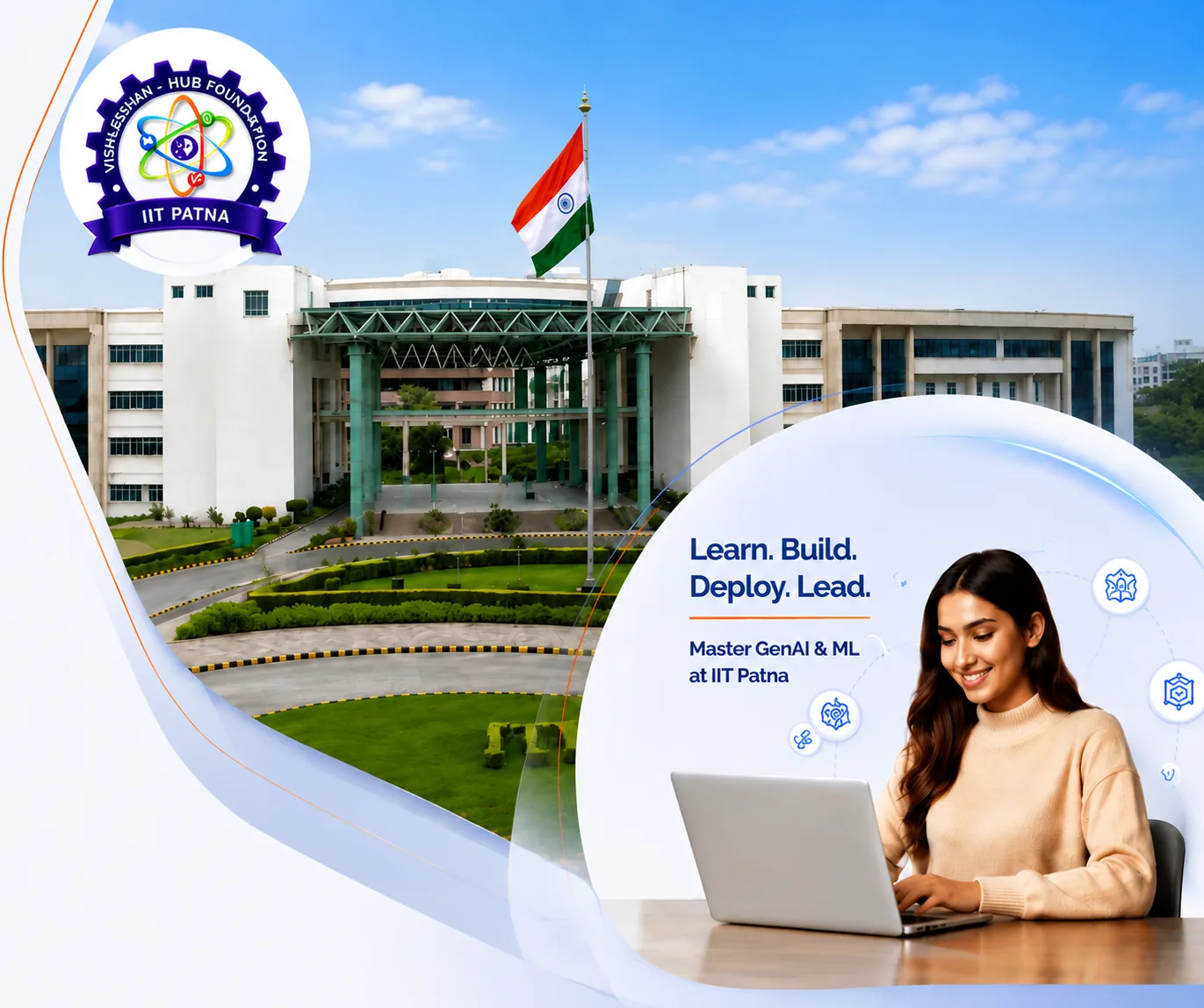
IIT Patna campusIIT Patna at a glance
Established
2008
NIT Ranking
Top 10
Research Papers
500+
Industry Partners
50+

AI Agent Development Course — Common Questions

An agentic AI course teaches you to build AI systems that pursue goals autonomously — planning, calling tools, using memory and correcting themselves — rather than answering a single prompt. Skillfyme's programme is built for developers, AI engineers and automation professionals who can already write Python and want to ship production agents with LangGraph, CrewAI and AutoGen.