
DevOps Course in Hyderabad
Hyderabad’s DevOps market is shaped by large enterprise and global capability centres, particularly around HITEC City and Gachibowli. Hiring here leans toward established engineering organisations running regulated or large-scale workloads, which puts more weight on release governance, compliance and change management than a startup-heavy market would.
How it works
There is no separate Hyderabad batch and no Hyderabad classroom. Classes are live and instructor-led, delivered online from Bangalore to one national cohort — so you join the next intake rather than waiting for a local batch to fill.
DevOps hiring in Hyderabad
Because so much of the local engineering base sits inside global capability centres of international firms, DevOps work here often means operating within an existing platform rather than building one from scratch. Familiarity with enterprise CI/CD, audit trails and controlled release processes carries further in Hyderabad interviews than in a startup market.
Engineering presence
- Microsoft
- Amazon
- Salesforce
- Deloitte
- Tech Mahindra
- ServiceNow
Roles advertised locally
- DevOps Engineer
- Cloud Engineer
- Release Engineer
- Site Reliability Engineer
What DevOps work looks like in Hyderabad
Hyderabad’s DevOps work is disproportionately shaped by the global capability centre model, and that changes the job in concrete ways. The platform usually already exists. The pipeline was designed by a team in another country, the tooling was standardised before you joined, and your work is to operate, extend and harden it rather than to choose it. Engineers who enjoy greenfield tool selection often find this frustrating; engineers who like depth in a large, well-instrumented system tend to do well.
That inherited-platform reality puts unusual weight on change management. Release windows, approval chains, audit trails and rollback procedure are not bureaucratic overhead in a HITEC City GCC — they are the job. Interview questions here more often concern how you handled a controlled release or evidenced a change for audit than how you would architect something from nothing.
The second Hyderabad-specific factor is shift overlap. A large share of local engineering teams work hours that overlap US or European business time, which affects both on-call expectations and, practically, which training batch is attendable. It is the main reason the weekend cohort is the common choice for learners in this city.
Getting hired in Hyderabad
Show you can operate someone else’s platform
Most Hyderabad DevOps roles involve extending an existing enterprise toolchain, not selecting one. Evidence that you have worked inside an established CI/CD setup and improved it carries further than a from-scratch personal project.
Compliance vocabulary is a real differentiator
Regulated and large-scale workloads dominate here. Being able to talk precisely about change approval, segregation of duties, audit logging and controlled rollback separates candidates in a way it does not in a startup market.
Expect structured, multi-round processes
GCC hiring tends to run longer and more formally than product-startup hiring, often with a panel round. Prepare for process depth and scheduling lag rather than a fast two-round decision.
These are widely known engineering locations rather than hiring partners — naming them describes the local market, and is not a claim that any of them recruits Skillfyme graduates.
What the programme covers
The curriculum is identical for every learner regardless of city. It runs three months in the weekday batch or six months in the weekend batch, both covering the same material in live sessions.
Linux and shell scripting
Taught from first principles — the only prerequisite.
Git and version control
Branching strategies and pull-request workflows.
Docker and containers
Images, registries, multi-stage builds, networking.
Kubernetes orchestration
Deployments, services, ingress and cluster operations.
Terraform and IaC
State, modules and reproducible environments.
CI/CD pipelines
Jenkins and GitHub Actions, built rather than described.
AWS cloud infrastructure
Compute, networking, storage and identity.
AI and AIOps
IaC generation, build-failure prediction, incident triage.
The full module-by-module syllabus, batch dates and fee breakdown are on the DevOps with AI Masters Program page. If you are still comparing providers, our guide to choosing a DevOps course in India sets out what to check before paying.
Your certificate
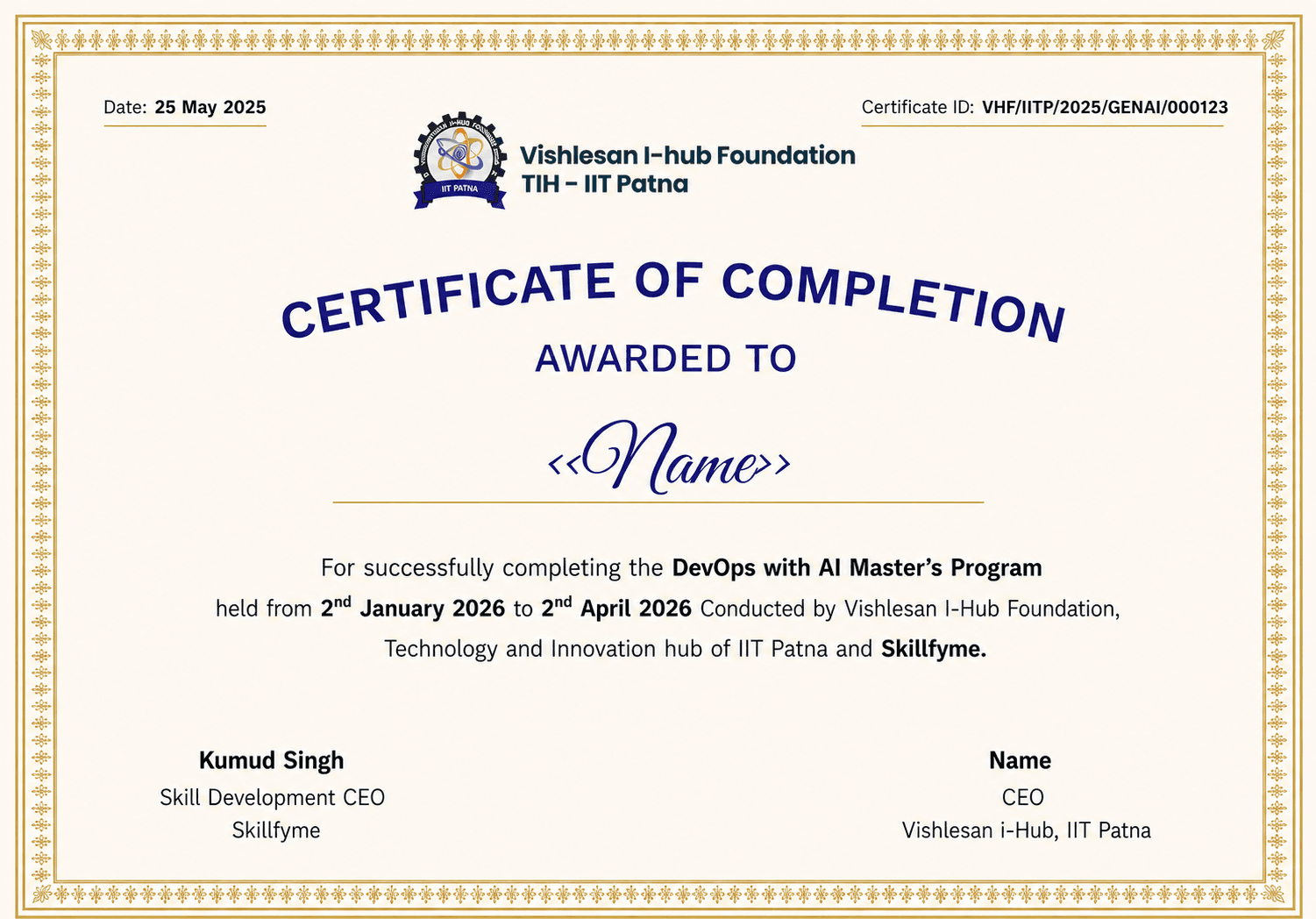
Issued jointly with Vishlesan i-Hub, IIT Patna on completion of the programme and its project work — the same credential for every learner in the cohort, wherever they attend from.
Attending from Hyderabad
The live cohort runs on IST, the same clock Hyderabad works to, so there is no time difference to manage. Learners in global capability centres on overlapping shifts typically choose the weekend batch.
DevOps course in Hyderabad: frequently asked questions
Is there a DevOps batch in Hyderabad?
Not a separate one. Skillfyme runs a single live online cohort delivered from Bangalore, and engineers in Hyderabad join that same cohort rather than a regional batch. There is no Hyderabad classroom and no city-specific start date, which also means there is no local batch to wait for — you join the next national cohort. Classes are live and instructor-led, not pre-recorded, so you can ask questions in real time regardless of where you are.
What does the DevOps job market in Hyderabad look like?
Because so much of the local engineering base sits inside global capability centres of international firms, DevOps work here often means operating within an existing platform rather than building one from scratch. Familiarity with enterprise CI/CD, audit trails and controlled release processes carries further in Hyderabad interviews than in a startup market. Companies with significant engineering operations in Hyderabad include Microsoft, Amazon, Salesforce, Deloitte and Tech Mahindra. The role titles you will most often see advertised locally are DevOps Engineer, Cloud Engineer, Release Engineer and Site Reliability Engineer. This is a description of the local market, not a statement that any named company recruits Skillfyme graduates.
When do classes run for someone working in Hyderabad?
The live cohort runs on IST, the same clock Hyderabad works to, so there is no time difference to manage. Learners in global capability centres on overlapping shifts typically choose the weekend batch. The weekday batch runs for three months and the weekend batch for six, with both covering the identical curriculum — the weekend track spreads the same content over a longer period for working professionals. Sessions are recorded, so a missed class can be caught up.
What does the DevOps training in Hyderabad cover, and how do the classes work?
The DevOps training covers eight modules in sequence: Linux and shell scripting, Git, Docker, Kubernetes, Terraform, CI/CD with Jenkins and GitHub Actions, AWS, and AI and AIOps for DevOps. DevOps classes for learners in Hyderabad are live and online: an instructor teaches each session in real time, you work through hands-on labs on cloud infrastructure, and every class is recorded for catch-up. Each module ends in project work that joins the tools into a working delivery pipeline — the skills DevOps Engineer and Cloud Engineer roles in Hyderabad are hired on. There is no Hyderabad classroom; the same live online classes are attended from every city.
What does the programme cost?
The programme fee is Rs 64,000, currently offered at Rs 45,000, payable in twelve monthly instalments of about Rs 3,750. Pricing is the same wherever you join from — there is no city-specific fee. Enrolment can be cancelled within three days of purchase under the refund policy.
What do I need to know before joining?
Basic familiarity with the Linux command line and shell scripting is the only prerequisite, and both are taught from first principles in the live sessions. No prior Kubernetes, Terraform or machine learning experience is assumed. The programme suits software engineers, system administrators, cloud engineers, QA engineers moving into automation, and final-year engineering students targeting a DevOps role.
Who issues the certificate?
Certification is issued jointly with Vishlesan i-Hub, IIT Patna — the Technology Innovation Hub at IIT Patna, established under the National Mission on Interdisciplinary Cyber-Physical Systems. It is a professional certification rather than an academic degree: it is not an MS or MSc in DevOps and carries no UGC recognition or academic credit.
What placement support is included?
Placement support covers interview preparation and resume reviews. It is described as support rather than a guarantee, and there is no percentage claim attached to it. Support is the same regardless of which city you join from.