Navigate

Where to?
Pick your path.

Joint certification · Vishlesan i-Hub, IIT Patna

Generative AI & Agentic AI Masters Course

GenAI With ML is a live, mentor-led generative AI and agentic AI course in India — LLMs, RAG, LangGraph and multi-agent systems for developers and data professionals.

Format
100% live, instructor-led classes
Duration
4 or 6 months · weekday or weekend batches
Hands-on
20+ real-world case studies · 10+ industry tools
Next cohort
Starts 14th Nov · Seats filling fast
20K+
Students
93%
Placed
60%
Avg. Salary Hike
60 LPA
Super-Dream CTC
Placement assistance for 1.5 years4.8 on Google · 2,400+ reviews

From Python to production agents, in seven modules

  1. 01Python & StatisticsPython, data analysis, visualisation
  2. 02Applied Machine LearningRegression, classification, ensembles
  3. 03Deep LearningNeural networks, CNNs, tuning
  4. 04Natural Language ProcessingNER, sentiment, translation, speech
  5. 05Generative AI & PromptingTransformers, GANs, prompt engineering
  6. 06LLM Application DevelopmentRAG, vector databases, fine-tuning, evaluation
  7. 07Agentic AI & LLMOpsLangGraph, CrewAI, AutoGen, AgentOps, CI/CD
  8. 5+ capstone projectsBuilt and deployed end to end
  • LangChain
  • LangGraph
  • CrewAI
  • AutoGen
  • Milvus
  • Hugging Face
  • FastAPI
  • Docker

Our learners got hired at 300+ companies

Companies where Skillfyme learners work today.

Plus fast-growing startups hiring for GenAI roles

Great experience with the Gen AI course! The sessions were easy to follow, and the trainer explained everything in a simple and practical way. I really liked the hands-on approach—it made learning much more interesting. Definitely recommend it!

Vishnudath PS Google review, 5 out of 5 (opens in a new tab)

Really enjoyed the Gen AI course! The trainer was supportive and the practical sessions made learning easy and interesting.

Aravind Radhakrishnan Google review, 5 out of 5 (opens in a new tab)

I enrolled in the Gen AI course, and it has been a really good experience. The content is well-structured, and the sessions are very informative. I would definitely recommend this course to others.

Pranav TP Google review, 5 out of 5 (opens in a new tab)

I recently joined the GenAI with Machine Learning program from Skillfyme. The classes are easy to follow and the trainers explain things in a simple way. Even if you are not from a strong technical background, you can understand the concepts. Practical examples make learning more interesting.

Sushmitha Google review, 5 out of 5 (opens in a new tab)

I joined the Gen AI with ML Masters Program to understand how AI and machine learning work beyond just tools. The program breaks things down step by step, from basics to practical applications. It helped me understand real-world use cases and improved my confidence with AI tools and concepts.

Koushik Bogapuram Google review, 5 out of 5 (opens in a new tab)

I joined a Generative AI course from Skillfyme to upgrade myself, and it turned out to be a great decision. The course is simple, practical, and focuses on real-life applications like improving efficiency and handling tasks faster. Very helpful for working professionals.

Anoop Kumar Google review, 5 out of 5 (opens in a new tab)

Ready to be the next review?

Free 1:1 career call · Callback in 15 min

Generative AI with ML Masters Program

Custom-made for every domain. A hands-on, mentor-led program covering every layer of the modern AI stack, from foundational ML to production-grade GenAI and LLMOps.

You, today. A fresher or 15 years in, from any domain.

  1. Your learning, your pace

    Every module, Python, ML, Deep Learning, NLP, GenAI, LLMs, Agentic AI and LLMOps, comes with guided mentorship. Live classes, weekday or weekend.

    4 or 6 months · + up to 6 extra months of handholding

    Python to LLMOps
  2. Showcase work that gets you hired

    Ship LLM apps, GenAI agents, MLOps pipelines and ML projects as you learn. Build a portfolio that stands out.

    Published where recruiters look

    GitHubKaggleLinkedIn
  3. Capstone project

    Bring a real business problem from your office or dream company, and solve it end to end with an expert project guide.

    Your domain · your problem · deployed

    Shipped with
  4. End-to-end career acceleration

    Resume building, mock interviews, system design prep and soft skills training for AI/ML, MLOps and GenAI roles.

    AI/ML Engineer · MLOps Engineer · GenAI Engineer

    Learners hired atGoogleMicrosoftAmazonDeloitte

Your next role in AI.

Still not sure? Talk to us.

We call you back within 30 mins · No spam · Free guidance

Everything that comes with your seat

Six things you get. Tap any one to see it in action.

Live classes with expertsAsk in class, get answers on the spot.

Built to fit around your job

Here is a typical week. Pick the batch that suits your schedule.

  1. 1h self-study, up to 2 hours
    Mon
  2. 1h self-study, up to 2 hours
    Tue
  3. 1h self-study, up to 2 hours
    Wed
  4. 1h self-study, up to 2 hours
    Thu
  5. 1h self-study, up to 2 hours
    Fri
  6. 3h live class
    Sat
  7. 3h live class
    Sun
Live classSelf-study, 1–2h (dashed: the optional second hour)
Live class a week
6h
Saturday and Sunday, 3 hours each, 8:00–11:00 AM IST. Your weekdays stay free for work.
Self-study a day
1–2h
To practise and finish assignments at your own pace.
To finish
6mo
The same full curriculum, spread over weekends.

Projects as you go

Every module has its own project, so you build while you learn. At the end you complete two capstone projects.

Missed a class? You lose nothing

Every class is recorded, with lifetime access that is never revoked. Missed a few? Join a fresh batch: access to live sessions is lifetime too.

Which path fits you?

Non-IT, fresher or twenty years in: there is a way in for you. Three taps show yours.

  1. 1Background
  2. 2Experience
  3. 3Goal
  4. ✓Your path

What do you do today?

Pick the closest. Every background has a way in.

Generative AI course curriculum, module by module

From Python to production-grade LLMOps. Seven modules on one line: pick any stop to see every class.

Module 1 · Python & Statistics Essentials

After this module: Write clean Python, work with data and turn it into analysis and charts.

8live classes

Your journey: 8 of 54 live classes done after this module

Every class in this module

  1. Python Programming Fundamentals
  2. Data Structures, Control Flow, and File Operations
  3. Functions For Python
  4. Object-Oriented Programming For Python
  5. Exception Handling For Python
  6. Data Analysis
  7. Data Visualization
  8. Case Studies

Full Generative AI and Agentic AI course syllabus

Module 1 · Python & Statistics Essentials

  • Class 1: Python Programming Fundamentals
  • Class 2: Data Structures, Control Flow, and File Operations
  • Class 3A: Functions For Python
  • Class 3B: Object-Oriented Programming For Python
  • Class 3C: Exception Handling For Python
  • Class 4A: Data Analysis
  • Class 4B: Data Visualization
  • Class 5: Case Studies

Module 2 · Applied Machine Learning

  • Class 1: Data Pre-processing and Feature Engineering
  • Class 2: Supervised Learning – Regression
  • Class 3: Supervised Learning – Classification
  • Class 4: Unsupervised Learning
  • Class 5: Clustering Algorithms & Dimensionality Reduction
  • Class 6: Ensemble Learning
  • Self-paced: Time Series Analysis & Reinforcement Learning
  • Self-paced: Recommender Systems

Module 3 · Deep Learning & Neural Network Architectures

  • Class 1: Neural Networks & Deep Learning Foundations
  • Class 2: Tuning & Optimizing Deep Neural Networks
  • Class 3: Convolutional Neural Networks – I
  • Class 4: Convolutional Neural Networks – II
  • Self-paced: Recurrent Neural Networks
  • Self-paced: Long Short-Term Memory (LSTM) Networks

Module 4 · Natural Language Processing (NLP)

  • Class 1: Introduction to NLP
  • Class 2: Text Processing & Feature Engineering
  • Class 3: Named Entity Recognition (NER) & Parsing
  • Class 4: Tokenization & Text Encoding
  • Class 5: Sentiment Analysis Essentials
  • Class 6: Advanced Sentiment Analysis
  • Class 7: Neural Language Models
  • Class 8: Machine Translation
  • Class 9: Speech & Multimodal NLP

Module 5 · Generative AI Essentials & Prompt Engineering

  • Class 1: Introduction to Generative AI
  • Class 2: Autoencoders & GANs
  • Class 3: Transformers & Attention Mechanism
  • Class 4: Small Language Models
  • Class 5: Prompt Engineering Essentials
  • Class 6: Advanced Prompting Strategies

Module 6 · LLM-based Application Development

  • Class 1: Introduction to Large Language Models (LLMs)
  • Class 2: Open Source LLMs & Model Variants
  • Class 3: Vector Databases
  • Class 4: Retrieval-Augmented Generation (RAG) Techniques
  • Class 5: LLM Frameworks & Development
  • Class 6: LLM Application Development
  • Class 7: Fine-tuning & Model Adaptation
  • Class 8: Generative AI Application Deployment
  • Class 9: LLM Caching & Routing Techniques
  • Class 10: Evaluation, Metrics, and Responsible AI for LLMs

Module 7 · Agentic AI & LLMOps for Scalable AI Systems

  • Class 1: Agentic AI Essentials
  • Class 2: Architectures & Design Patterns
  • Class 3: Working with LangChain & LCEL
  • Class 4: Building AI Agents with LangGraph
  • Class 5: Implementing Agentic RAG
  • Class 6: Developing AI Agents with Phidata
  • Class 7: Multi-Agent Systems with LangGraph & CrewAI
  • Class 8: Advanced Agent Development with Autogen
  • Class 9: AI Agent Observability & AgentOps
  • Class 10: RAG Architecture with Vector DBs
  • Class 11: Continuous Integration, Deployment & Scaling LLMs

Generative AI vs Agentic AI

One course, both skills. Generative AI produces content from a prompt. Agentic AI uses the same models to plan, call tools and finish multi-step tasks. Every agent is an LLM application underneath, so this generative AI and agentic AI course teaches generative AI first, then agentic AI built on top of it.

Generative AI compared with agentic AI on five points, and where each is taught in this course
Generative AIOne prompt in, one answer out.PromptLLMOne passAnswerAgentic AIOne goal in, a finished task out.GoalLLM plansCalls a toolChecks the resultRepeats until the task is doneTask done
What it doesCreates text, code, images or answers from a prompt, grounded in your own data when needed.Works through a multi-step task: plans, calls a tool, checks the result and repeats until the job is done.
Core building blocksTransformers and attention, prompt engineering, large language models, vector databases and retrieval-augmented generation (RAG).Agent architectures and design patterns, tool calling, agentic RAG and multi-agent orchestration.
Frameworks you useOpen-source LLMs and model variants, LLM frameworks, vector databases and fine-tuning for model adaptation.LangChain and LCEL, LangGraph, CrewAI, AutoGen and Phidata.
What you buildLLM applications and RAG systems, then deploy them as generative AI applications.AI agents with LangGraph and Phidata, agentic RAG pipelines and multi-agent systems with LangGraph and CrewAI.
Running it in productionLLM caching and routing, evaluation metrics and responsible AI for LLMs.Agent observability and AgentOps, CI/CD, deployment and scaling of LLM systems.

The order you learn them in

Agents are built on LLM applications, so generative AI comes first.

See every class
  1. Modules 1–4FoundationsPython and statistics, machine learning, deep learning and NLP27 live classes
  2. Modules 5–6Generative AIGenerative AI essentials, prompt engineering and LLM application development16 live classes
  3. Module 7Agentic AI & LLMOpsAgentic AI and LLMOps for scalable AI systems11 live classes

Agentic AI & GenAI tools we cover

All 44 tools below are taught in the curriculum, module by module. Watch them play through, or pick a module.

  1. 01
    Python

    Write every model, pipeline and agent in the course.

  2. 02
    Jupyter

    Explore data and run experiments in notebooks.

  3. 03
    NumPy

    Handle arrays and the maths under every model.

  4. 04
    pandas

    Load, clean and reshape tabular data.

  5. 05
    Matplotlib

    Plot data and model results.

  6. 06
    Seaborn

    Draw statistical charts in a few lines.

Agentic AI and GenAI tools covered, by module

  1. Module 1, Python & Statistics: Python, Jupyter, NumPy, pandas, Matplotlib, Seaborn.
  2. Module 2, Machine Learning: scikit-learn, XGBoost, LightGBM, CatBoost.
  3. Module 3, Deep Learning: TensorFlow, Keras, PyTorch, Optuna.
  4. Module 4, Natural Language Processing: spaCy, Hugging Face, NLTK.
  5. Module 5, Generative AI & Prompting: OpenAI, Mistral, LangChain, DSPy, Guidance.
  6. Module 6, LLM Applications: Llama, LlamaIndex, Milvus, Weaviate, Docker, Kubernetes, FastAPI, NVIDIA Triton, FAISS, Chroma, Pinecone, vLLM.
  7. Module 7, Agentic AI & LLMOps: LangGraph, CrewAI, AutoGen, DVC, GitHub Actions, AWS, Google Cloud, Azure, Phidata, LangSmith.

21 GenAI & Agentic AI skills, one production loop

By the end of the program you can build an AI system, ship it and keep it healthy in production. Every skill below has its place in that loop.

  1. Build it

    Stage 1: Prepare

    Get data into a shape a model can learn from.

    • Python Programming
    • Feature Engineering
  2. Build it

    Stage 2: Train & tune

    Turn that data into models that hold up.

    • Hyperparameter Tuning
    • LLM Fine-tuning
  3. Build it

    Stage 3: Build with LLMs

    Ground models in your data and give them tools.

    • RAG Architecture
    • Vector Retrieval
    • Agentic AI Systems
    • Workflow Orchestration
  4. Run it

    Stage 4: Ship

    Get it to users, through pipelines, on any cloud.

    • MLOps Pipeline Design
    • CI/CD Automation
    • Model Deployment
    • Advanced Deployments
    • Multi-cloud Integration
  5. Run it

    Stage 5: Track

    Know which version is live, and why.

    • Model Versioning
    • Model Registry
    • MLFlow
    • LLM Lifecycle Management
  6. Run it

    Stage 6: Operate

    Keep it accurate, fast and affordable.

    • Model Performance Monitoring
    • Metrics Monitoring
    • Cost Optimization
    • Retraining Automation

Then it runs again. Monitoring spots drift, fresh data comes in, and the loop starts back at 01.

Generative & Agentic AI projects

A project in every module, then two capstones. Here are the seven module projects and the advanced capstone, each modelled on how a company you know runs AI in production.

WalmartModule 1 · Python & StatsInspired by Walmart

Uncover what drives store sales

Walmart studies sales across stores and seasons to plan what to stock.

What you'll learn

  • Exploratory data analysis with pandas
  • Summary statistics that answer business questions
  • Two or three charts that tell the story

Tools

PythonpandasNumPySeabornJupyter

Taught inModule 1 · Session 4: Data Analysis and Visualization

01 / 08
  1. 1Load the sales dataPythonpandas
  2. 2Clean and explorepandasNumPy
  3. 3Visualise the trendsMatplotlibSeaborn
  4. 4Share the storyJupyter

You shipAn EDA notebook with charts that explain what drives sales

Projects are modelled on systems these companies have described publicly and are built on open data. The companies are not partners of this program.

Projects in the program

  1. Module 1, Uncover what drives store sales, inspired by Walmart: Walmart studies sales across stores and seasons to plan what to stock. Steps: Load the sales data, Clean and explore, Visualise the trends, Share the story. Tools: Python, pandas, NumPy, Matplotlib, Seaborn, Jupyter. Taught in Module 1 · Session 4: Data Analysis and Visualization.
  2. Module 2, Predict which shoppers will churn, inspired by Flipkart: Flipkart predicts which shoppers may stop buying so it can win them back. Steps: E-commerce order history, Engineer and encode features, Random Forest, XGBoost, CatBoost, Stack and compare. Tools: pandas, scikit-learn, XGBoost, CatBoost. Taught in Module 2 · Session 6: Ensemble Learning.
  3. Module 3, Recognise dishes from food photos, inspired by Zomato: Zomato uses deep learning to understand the food photos people upload. Steps: Food photos, Augment and tune, Fine-tune ResNet, Explain, then shrink for mobile. Tools: Python, Optuna, PyTorch, Keras, TensorFlow. Taught in Module 3 · Sessions 2–4: Tuning, CNNs I and II.
  4. Module 4, Find what reviewers love and hate, inspired by Amazon: Amazon analyses product reviews to surface what customers say about each feature. Steps: Product reviews, Clean and tokenise, TF-IDF baseline, Fine-tuned BERT, per aspect. Tools: pandas, spaCy, scikit-learn, Hugging Face, NLTK. Taught in Module 4 · Sessions 5–6: Sentiment Analysis.
  5. Module 5, Summarise customer calls with a prompt library, inspired by American Express: American Express uses generative AI to help colleagues handle customer conversations. Steps: Call transcripts, Zero-shot vs few-shot, Chain-of-thought checks, Multi-step chain. Tools: Python, OpenAI, LangChain. Taught in Module 5 · Sessions 5–6: Prompt Engineering.
  6. Module 6, A research assistant that cites its sources, inspired by JPMorgan Chase: JPMorgan has rolled out an LLM suite to help its people work with internal documents. Steps: Research PDFs, Embed and index, RAG with Llama, Fine-tune with LoRA, Serve, cache and route. Tools: LlamaIndex, Hugging Face, LangChain, Llama, FastAPI, Docker, Kubernetes, FAISS, Chroma. Taught in Module 6 · Sessions 3–9: Vector DBs to Caching & Routing.
  7. Module 7, Ask the database in plain English, inspired by Uber: Uber built QueryGPT so employees can turn a question into a working SQL query. Steps: A plain-English question, Branch to the right tables, Agent runs the SQL, Retry, check and explain. Tools: LangChain, LangGraph, OpenAI, Phidata, LangSmith. Taught in Module 7 · Sessions 2, 4 and 6: Patterns, LangGraph, Phidata.
  8. Capstone, An enterprise support agent team, inspired by Airbnb: Airbnb uses large language models to help resolve guest and host support conversations. Steps: Ticket arrives, Agent team takes it, RAG over policies, Cache and route models, Ship with CI/CD. Tools: FastAPI, LangGraph, CrewAI, AutoGen, Milvus, OpenAI, Docker, GitHub Actions, AWS, LangSmith. Taught in Capstone 2: Enterprise-Grade Agentic AI System.

Sit in on a real live class

Two recorded live sessions from this program. See how classes run before you pay a rupee.

Four quick questions. No payment needed.

The future of Generative AI and Agentic AI

AI is transforming industries worldwide, and the market is still at the bottom of its curve. Here is where you would join it.

85% of the growth is still ahead of you.

Generative AI revenue is forecast to grow from $40B in 2022 to $1.3T by 2032. Most of that climb comes after you graduate in 2027.

$4.4T
a year in value generative AI could add to the global economyMcKinsey Global Institute, 2023 · range $2.6T–4.4T
170M
new jobs by 2030, with AI roles among the fastest growingWorld Economic Forum, Future of Jobs Report 2025
Generative AI market revenue rising from 40 billion dollars in 2022 to 1.3 trillion dollars in 2032. Today is early on the curve; a learner graduating in 2027 joins before about 85 percent of the decade's growth.

Curve: steady ~42% yearly growth between Bloomberg Intelligence's 2022 ($40B) and 2032 ($1.3T) figures, June 2023; points between are the trend, not separate forecasts. $668B (2030): Fortune Business Insights, August 2023. McKinsey Global Institute, “The economic potential of generative AI”, June 2023. World Economic Forum, Future of Jobs Report 2025.

GenAI careers: what can I become?

Six roles, what each pays in India, and the companies hiring for them. Tap a badge to flip it.

Annual CTC in India. 300+ hiring partners · 2026 cohort hiring data. Actual offers depend on your experience, skills and interviews.

Real learners, real offers

Skillfyme learners who upskilled with us and moved to a better job. Each column rises by their salary hike.

  1. Swati, Skillfyme learnerSwatiPlaced atManipal IT
    +0%Before
  2. Vaibhav, Skillfyme learnerVaibhavPlaced at
    +0%salary hikeBefore
  3. Sindhiya, Skillfyme learnerSindhiyaPlaced at
    +0%salary hikeBefore
  4. Surya, Skillfyme learnerSuryaPlaced at
    +0%salary hikeBefore
  5. Pradeep, Skillfyme learnerPradeepPlaced at
    +0%salary hikeBefore
  6. Mukesh, Skillfyme learnerMukeshPlaced at
    +0%salary hikeBefore
  7. You?Your name hereYour next offer

From Skillfyme's Placement Diaries. Hikes are as reported by each learner; individual results vary.

What does day-to-day look like?

Nine AI roles this course prepares you for, and the real work each one does every day.

  1. ML

    Machine Learning Engineer

    Turns data into models that keep working in production.

    • Build, train, and evaluate ML models using real-world datasets.
    • Deploy ML pipelines on cloud (AWS, Azure, GCP) for scalability.
    • Automate feature engineering and preprocessing workflows.
    • Monitor model performance and retrain when accuracy drops.
    • Collaborate with data engineers and software teams to integrate ML into products.
  2. NLP

    NLP Engineer

    Builds systems that read, sort and understand text.

    • Process, clean, and analyze text datasets at scale.
    • Build NLP pipelines for tokenization, embeddings, and text classification.
    • Train and fine-tune language models for NER, sentiment, and summarization.
    • Integrate NLP models into chatbots, search, or recommendation systems.
    • Optimize pipelines for low latency and multilingual support.
  3. GenAI

    Generative AI Engineer

    Builds models that create text, images and audio, safely.

    • Experiment with GANs, VAEs, and diffusion models for generation tasks.
    • Fine-tune foundation models for creative use cases.
    • Work on prompt optimization for better output quality.
    • Ensure responsible AI practices — bias detection and content safety.
    • Collaborate with product teams to embed GenAI into user-facing applications.
  4. App Dev

    AI Application Developer

    Puts AI inside the apps people use every day.

    • Build end-to-end AI-powered web or mobile applications.
    • Integrate APIs, SDKs, and LLM frameworks into products.
    • Implement chatbots, recommendation engines, or AI copilots.
    • Work with UX teams to design AI-first user experiences.
    • Ensure performance, scalability, and real-time AI responses.
  5. Agents

    Agentic AI Engineer

    Builds AI agents that plan, use tools and finish tasks.

    • Design and develop AI agents that can reason, plan, and act.
    • Work with LangChain, LangGraph, Autogen, CrewAI, or Phidata.
    • Build multi-agent systems for research, coding, or automation workflows.
    • Implement observability, debugging, and AgentOps practices.
    • Optimize agents for collaboration, memory, and task efficiency.
  6. Architect

    AI Solutions Architect

    Designs the whole AI system and picks the right parts.

    • Design enterprise AI solutions and system architectures.
    • Choose appropriate ML/LLM frameworks and cloud services.
    • Ensure scalability, performance, and security of AI systems.
    • Guide cross-functional teams — data scientists, engineers, DevOps.
    • Translate business needs into AI-driven technical solutions.
  7. Product

    AI Product Manager

    Decides what an AI product should do, and proves it works.

    • Define AI product vision, roadmap, and business goals.
    • Translate user and business requirements into AI features.
    • Collaborate with engineering teams to build and launch AI products.
    • Track KPIs and product performance metrics rigorously.
    • Ensure ethical and responsible AI deployment at scale.
  8. Consulting

    AI Consultant

    Helps companies decide where AI pays off, and how to adopt it.

    • Advise clients on AI adoption strategy and roadmap.
    • Assess feasibility and ROI of AI initiatives.
    • Recommend tech stacks, tools, and platforms for AI projects.
    • Lead workshops and training sessions for client teams.
    • Ensure compliance with data privacy and AI ethics standards.
  9. Research

    Applied AI Scientist

    Turns new research into models that solve real problems.

    • Research and prototype advanced AI/ML models for practical problems.
    • Test new algorithms and benchmark against existing solutions.
    • Publish applied research in whitepapers or peer-reviewed journals.
    • Work on domain-specific applications — healthcare, finance, retail.
    • Bridge the gap between research and production deployment.
Roles 1–4 of 9

Build the foundation, then climb to an offer

Every career step stands on what you learned. Watch it build, or pick a step.

FOUNDATION · 9 LEARNING OBJECTIVES, PYTHON TO LLMOPSFOUNDATION · 9 OBJECTIVES01Role fit02Resume &LinkedIn03GitHubportfolio04Mockinterviews05JobinterviewsOFFEROFFER

The foundation

Nine learning objectives, from Python to LLMOps.

  1. 01Python & Data Foundations
  2. 02Building & Optimizing ML Models
  3. 03Deep Learning & Computer Vision
  4. 04Natural Language Processing
  5. 05Generative AI & Prompt Engineering
  6. 06Working with Large Language Models
  7. 07Developing GenAI Applications
  8. 08Agentic AI Development
  9. 09LLMOps & AI Scalability

About Vishlesan i-Hub, IIT Patna

Who stands behind your certificate.

IIT Patna campusIIT Patna at a glance
Established
2008
NIT Ranking
Top 10
Research Papers
500+
Industry Partners
50+

Generative & Agentic AI Certificate

Two certificates when you finish. Try one on.

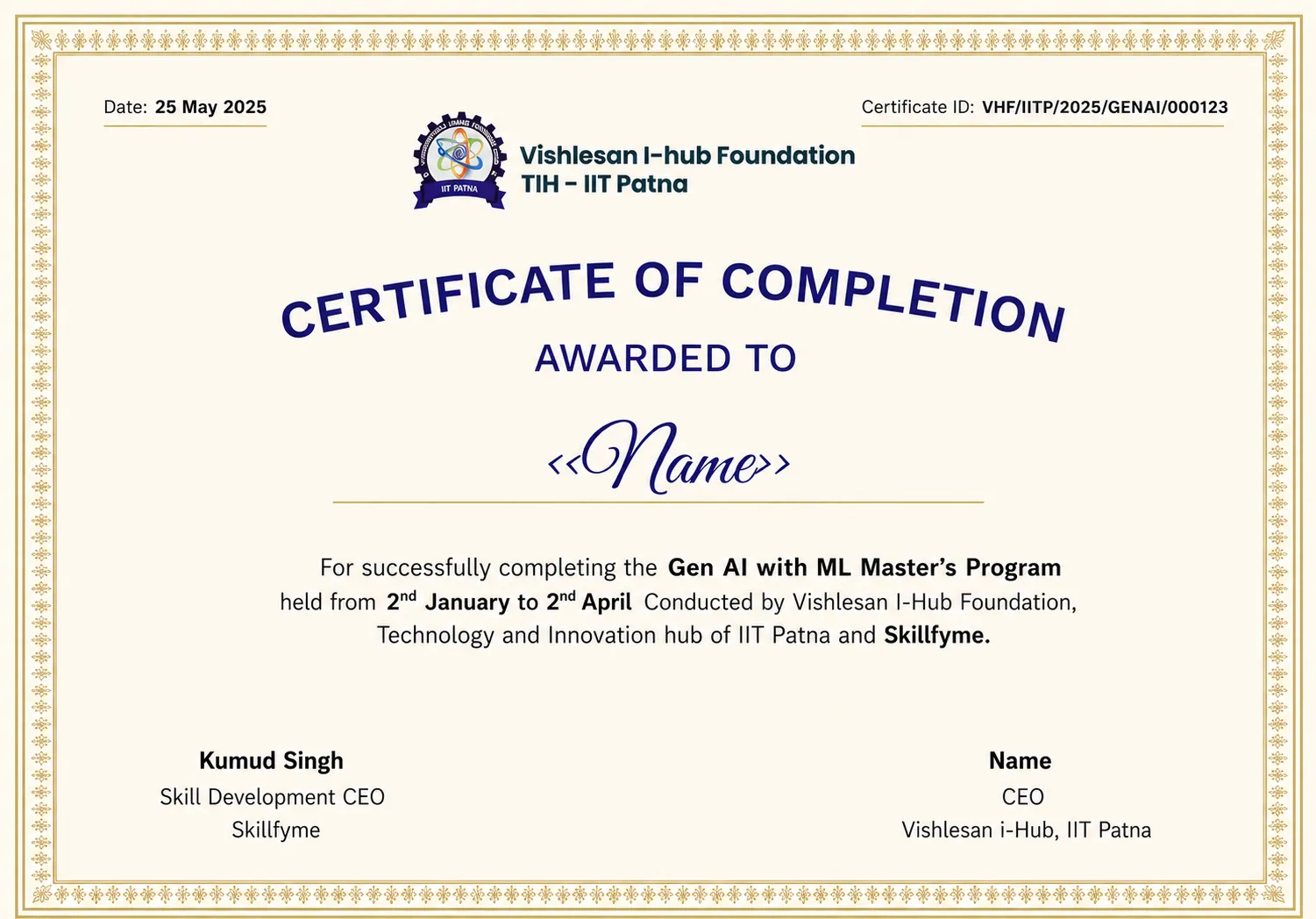
Sample joint certificate of completion from Vishlesan i-Hub Foundation, TIH of IIT Patna, and Skillfyme for the Gen AI with ML Master's Program

Joint certificate

Vishlesan i-Hub Foundation, TIH of IIT Patna, with Skillfyme

  • Issued by Vishlesan i-Hub Foundation, the Technology and Innovation Hub of IIT Patna, with Skillfyme
  • Co-signed by both organisations
  • Carries a unique certificate ID
  • Recognized Achievement

    Completing the program gives you an industry-recognized certificate and skills hiring managers look for.

  • Industry-Relevant Curriculum

    Developed by subject matter experts, covering crucial topics and the latest trends in GenAI and ML.

  • Practical Skills Focus

    Hands-on projects and real-world applications that prepare you for production AI roles.

Hear it from our learners

Skillfyme learners on camera, in their own words. Tap a face to watch.

Niharika

Data Analyst, non-CS background

A clear path from machine learning to GenAI, learned without a computer science background.

One generative AI course instead of six separate ones

Learners comparing generative AI courses are often pricing an LLM course, a RAG course and a LangChain course separately. This programme teaches them as phases of one live cohort, from Python and ML foundations to deployed agents.

The courses you were about to buy separately:

Included in this programme · Modules 5–6

Instead of a separate LLM course

Large language models from transformers upward, then LLM-based application development: building, evaluating and deploying applications on top of LLMs.

0

of 6 courses still to buy separatelyAll 6 are taught here: one live cohort, one fee.

How we compare with a typical GenAI course

Nine things to check before you pick a program.

Skillfyme GenAI With ML Masters Program compared with a typical online GenAI course
IncludedPartlyNot availableSkillfymeGenAI With ML Masterswith Vishlesan i-Hub, IIT PatnaTypical courseOnline GenAI programWhat most programs offer
What you learn
Curriculum breadthIncluded: Python, ML, DL, NLP, GenAI, LLMs, Agentic AI and LLMOpsPartly: Basics or niche topics; GenAI and agentic AI often missing
Beginners and professionalsIncluded: Python and statistics bootcamp for beginners; LLMOps and agentic AI for professionalsPartly: One track for everyone
GenAI and LLM depthIncluded: Transformers, prompting, RAG, fine-tuning, caching, routing and deploymentPartly: Surface-level GenAI, no deployment
Future skillsIncluded: MLOps and LLMOps tracks with LangChain, LangGraph, CrewAI and AutoGenPartly: Little depth in LLMOps
What you build
ProjectsIncluded: 50+ hands-on projects with real datasetsPartly: A few practice projects
CapstoneIncluded: A live problem from your company or a partner enterprisePartly: A fixed, academic-style project
Hands-on shareIncluded: 80–85% hands-on: pipelines, multi-agent systems, deploymentsPartly: Mostly theory and notebook demos
Who teaches and supports you
FacultyIncluded: IIT faculty and experts from Walmart, Harman, Meta, Microsoft and AI startups, with 1:1 project guidancePartly: Mostly platform tutors
Alumni networkIncluded: AI/ML professionals across FAANG, Fortune 500 and startupsPartly: Smaller, platform-only network

4 or 6 monthslive, instructor-led

Comparing us with a course you are already considering? An advisor can go through it with you, row by row.

“Typical course” describes what is common across online GenAI programs, not any one provider. Individual programs vary, so check the details of any course you are considering.

What you pay, and how

One program fee with no hidden costs. Pay it in full, or split it into no-cost monthly EMIs.

SkillfymeGenAI with ML Masters ProgramSeat reservation

Pay in full

₹50,000

₹68,000You save ₹18,000

One payment. No hidden costs.

Pay monthly

₹4,167/month

for 12 months · 0% interest

No-cost EMI on credit and debit cards. No processing fee.

EMI partners: Razorpay, ShopSe, Cashfree Paymentsand many more banks
Batch starts
14th Nov 2026
Class time
8:00 – 11:00 AM IST
Mode
Live online
Seats
Seats filling fast

Reserve your seat

₹50,000 or ₹4,167/mo

A one-minute form.
An advisor calls you next.

What happens after you click Enroll

  1. Fill a short form

    Your name, email, phone and experience. It takes a minute.

  2. An advisor calls you

    Ask anything, and confirm the batch that suits you.

  3. Choose how to pay

    Pay in full, or split it into no-cost EMIs.

  4. Start on 14th Nov

    Get your welcome kit and batch access.

Your questions, answered

Everything to know before you enroll. Start with the quick answers, or search any question.

₹50,000, or ₹4,167 a month for 12 months with no-cost EMI.

The program fee is ₹68,000, currently ₹50,000. You can pay it in full, or split it into 12 no-cost EMIs of about ₹4,167 a month.

No-cost EMI is available on credit and debit cards, with 0% interest and no processing fee. There are no hidden costs on top of the program fee.

The next batch starts on 14th Nov 2026, with live classes from 8:00 to 11:00 AM IST.

The next batch starts on 14th Nov 2026. Live classes run from 8:00 to 11:00 AM IST.

You can choose the weekday batch, which finishes in 4 months, or the weekend batch, which spreads the same curriculum over 6 months. An advisor confirms the batch that suits your schedule before you pay.

Fill a short form, an advisor calls you, you choose how to pay, then you start your batch.

Enrolling takes four steps:

  • Fill a short form with your name, email, phone and experience.
  • An advisor calls you to answer your questions and confirm the batch that suits you.
  • You choose how to pay: in full (₹50,000) or with no-cost EMI (₹4,167 a month).
  • You get your welcome kit and batch access, and start learning.

Yes. A 100% refund within 3 days of enrollment.

Yes. We offer a 100% refund within 3 days of enrollment. After 3 days, no refunds are issued.

Yes. You pay through a secure gateway in your local currency.

Yes. Classes are live online, so you can join from anywhere. Learners outside India pay through a secure payment gateway with multiple payment methods, in their local currency at transparent rates.

The same 3-day refund policy applies. No-cost EMI is offered on Indian credit and debit cards.

4 months in the weekday batch, or 6 months in the weekend batch.

The program runs for 6 months in the weekend batch or 4 months in the weekday batch. Both tracks follow the same curriculum and the same live instructor-led format; the weekend track spreads identical content over a longer period for working professionals.

Mostly live, instructor-led classes, with a few self-paced topics.

Mode
Live (majority) plus self-paced (select topics).
Schedule
The weekend batch runs on weekends, 3 hours per session; a weekday batch is also available.
Support
Recorded sessions, doubt-clearing and mentorship.

Every session is recorded, so you can catch up.

All sessions are recorded and uploaded. You also receive assignments, notes and doubt-clearing sessions to stay on track.

No. Python, statistics and ML basics are taught in class.

No. We cover all prerequisites in class (Python, statistics and ML basics).

  • Beginners can learn from scratch.
  • Experienced professionals can use it as a quick refresher.

1:1 doubt support around the clock, mentorship, a learner community and career help.

  • 1:1 mentorship and doubt clearing, available 24/7
  • A dedicated Slack/Discord learner community
  • Career guidance, resume reviews and interview preparation

Yes. You get lifetime access to live sessions, recordings, resources and the LMS.

Yes. You keep lifetime access to the live sessions, the recordings and resources, and the learning management system (LMS), so you can revisit any topic long after you finish.

Yes. Full lab access, so you practise on real tools.

Yes. You get full lab access for hands-on learning, so you practise on real tools rather than only watching slides. About 80–85% of the program is hands-on: labs, assignments and projects.

Yes. Agentic AI is a full phase, taught hands-on with LangChain, LangGraph, CrewAI, Phidata and Autogen.

Yes. Agentic AI is a full phase of the programme, not a single bonus module. It is taught hands-on with LangChain, LangGraph, CrewAI, Phidata and Autogen, building autonomous agents and multi-agent systems that plan, call tools and coordinate with one another.

That work sits on top of retrieval-augmented generation (RAG) with vector databases (FAISS, Pinecone, Weaviate and Milvus), so agents answer from real data rather than model memory, and finishes with deployment and monitoring under MLOps and LLMOps. The capstone is an enterprise-grade RAG chatbot and a multi-agent system built with LangGraph and CrewAI.

Three phases: foundations, then NLP and generative AI, then LLMs and agentic AI.

Phase 1 (Foundations)
Python, statistics, ML, deep learning
Phase 2 (NLP + Generative AI)
NLP, transformers, prompting
Phase 3 (LLMs & Agentic AI)
RAG, LLMOps, multi-agent AI systems

Python, PyTorch, Hugging Face, LangChain, LangGraph, CrewAI, vector databases, Docker and Kubernetes, among others.

ML/DL
Python, NumPy, Pandas, Scikit-learn, XGBoost, PyTorch, TensorFlow
Generative AI
Hugging Face Transformers, LangChain, LangGraph, CrewAI, Phidata and Autogen
Vector DBs
FAISS, Pinecone, Weaviate, Milvus
Deployment
Docker, Kubernetes, CI/CD, LLMOps tools
Cloud
AWS, Azure, GCP

80–85% hands-on, 15–20% theory.

80–85% hands-on (labs, assignments, projects) and 15–20% theory (concepts, maths, foundations).

Yes, end to end: training, fine-tuning, RAG, deployment, monitoring and scaling.

Yes. You practise end-to-end workflows: training → fine-tuning → RAG → deployment → monitoring → scaling.

So live time goes to the skills in highest demand: transformers, LLMs and agentic AI.

Market relevance
Transformers and LLMs dominate modern AI.
Time optimisation
Live sessions prioritise high-demand skills like generative AI, LLMs and agentic AI.
Flexibility
Self-paced topics are still available for foundational coverage.

Because companies are investing heavily in LLM automation, copilots and multi-agent systems.

Companies are heavily investing in LLM-based automation, copilots and multi-agent systems, and agentic AI is the next frontier in enterprise AI adoption.

Traditional ML/DL is still covered, but the emphasis is on cutting-edge, high-demand skills.

Yes. They are taught first, as the foundation for generative AI.

Yes. Classical ML/DL powers predictive analytics, recommendation systems, fraud detection and edge AI. We make sure you build a solid foundation before advancing into generative AI.

Yes, two: a joint certificate with Vishlesan i-Hub (IIT Patna) and a Skillfyme certificate of completion.

Yes, two. When you complete the program and its projects, you receive a joint certificate from Vishlesan i-Hub Foundation, the Technology Innovation Hub of IIT Patna, with Skillfyme, and a Skillfyme certificate of completion. Each carries a unique certificate ID.

This is a professional certification programme, not a university MS or MSc in generative AI. It is taught by practising engineers and assessed through real project work rather than academic examination.

Certification is issued jointly with Vishlesan i-Hub, IIT Patna's Technology Innovation Hub. It is not an IIT degree.

Certification is issued jointly with Vishlesan i-Hub, the Technology Innovation Hub at IIT Patna, and covers the whole programme including the generative AI and agentic AI phases. Vishlesan i-Hub is a Section 8 non-profit incorporated in 2020 on the IIT Patna campus at Bihta, working on speech, video and text analytics, which is directly adjacent to what this course teaches.

To be precise about what it is and is not: this is a professional certification programme run with an IIT innovation hub, not an IIT degree, and not an MS or MSc in generative AI.

It is built to show applied, job-ready skills that match AI hiring trends.

Skillfyme's certification is designed to showcase applied, job-ready skills that align with industry hiring trends, especially in generative AI, LLMOps and AI engineering roles.

From ML fraud detection to an enterprise RAG chatbot and a multi-agent system.

  • Fraud detection with ML pipelines
  • Image classification with CNNs
  • Text summarisation and sentiment analysis
  • Enterprise-grade RAG chatbot (LangChain + vector DB)
  • Multi-agent AI system (LangGraph + CrewAI)
  • Generative AI app deployment with CI/CD

ML, NLP, LLM, generative AI and agentic AI engineering roles, up to AI architect and AI product roles.

  • Machine Learning Engineer
  • Deep Learning Engineer
  • NLP Engineer
  • Generative AI Engineer
  • LLM Engineer
  • AI Application Developer
  • Agentic AI Engineer
  • AI Solutions Architect
  • AI Product Manager / Consultant
  • Applied AI Scientist / AI Innovation Lead

Mid-level engineers move into AI engineering; seniors into AI architecture, product or consulting.

Mid-level (3–8 yrs)
Transition into AI/ML/LLM engineering roles.
Senior (8–20+ yrs)
Move into AI architecture, product leadership or consulting roles.

Yes: resume and LinkedIn branding, mock interviews, portfolio guidance, referrals and career mentorship.

Resume building & LinkedIn branding
Position yourself as an AI/LLM professional.
Mock interviews (tech + HR + system design)
Prepare for real-world interview scenarios.
Portfolio & project showcasing
Guidance on presenting your hands-on AI projects.
Referrals & job recommendations
Get referred to openings in our hiring network.
Career mentorship
Guidance on targeting roles like AI Engineer, AI Architect and AI Product Manager.

Yes: resume and portfolio review, interview preparation and career mentorship.

  • Resume building and portfolio review
  • Interview preparation (basic → advanced → system design)
  • Career mentorship for roles in ML, LLM, generative AI and agentic AI

Judge any course on live teaching, real projects, the certificate, agentic AI depth and total fee.

Judge any generative AI course in India on five things: whether classes are live or pre-recorded, whether you build real systems or watch demos, who issues the certificate, whether the syllabus reaches agentic AI and deployment rather than stopping at prompt engineering, and the total fee including EMI.

Skillfyme's program runs 4 months in the weekday batch or 6 months in the weekend batch, taught as live instructor-led classes, covering Python and ML foundations, deep learning, transformers, LLMs, RAG and agentic AI with LangGraph and CrewAI. Learners ship an enterprise-grade RAG chatbot and a multi-agent system rather than notebook exercises. Certification is issued jointly with Vishlesan i-Hub, IIT Patna. The programme fee is ₹68,000, currently ₹50,000, payable in twelve monthly instalments of about ₹4,167. Classes run online across India from Bangalore, so learners in Hyderabad, Delhi, Chennai, Pune and Mumbai attend the same live cohort.

Agents should be a real phase you build and deploy, not a bonus demo. Here they are.

Judge any agentic AI course on whether agents are a real phase or a bonus module, which frameworks you actually build in, whether the agents call real tools and real data, and whether you deploy anything. Most courses stop at prompt engineering and a chatbot demo.

Here agentic AI is a full phase: autonomous agents and multi-agent systems built hands-on with LangChain, LangGraph, CrewAI, Phidata and Autogen, that plan, call tools and coordinate with one another. It sits on retrieval-augmented generation with FAISS, Pinecone, Weaviate and Milvus so agents answer from real data, and finishes with deployment and monitoring under MLOps and LLMOps. The capstone is an enterprise-grade RAG chatbot and a multi-agent system built with LangGraph and CrewAI. Certification is joint with Vishlesan i-Hub, IIT Patna, and the fee is ₹68,000, currently ₹50,000.

In 2026 they are the same question: what separates a current syllabus is agents, RAG and deployment.

They are increasingly the same question, because what separates a current syllabus from a 2023 one is agents. Generative AI work moved past prompting: what teams hire for is retrieval over their own data, agents that call tools and take multi-step actions, and the evaluation and deployment discipline to keep any of it reliable.

The 2026 Edition reflects that: the syllabus runs from Python, statistics and ML foundations through deep learning and transformers to LLMs, RAG and agentic AI with LangGraph, CrewAI and Autogen, finishing with MLOps and LLMOps. This one is live instructor-led, 4 months weekday or 6 months weekend, certified jointly with Vishlesan i-Hub at IIT Patna, at ₹50,000 against a programme fee of ₹68,000.

Yes. Fully online, with live instructor-led classes over video, taught from Bangalore.

Yes, this is a fully online generative AI course. Classes are live and instructor-led over video, taught from Bangalore and attended across India, so learners in Hyderabad, Delhi, Chennai, Pune and Mumbai join the same cohort rather than a regional batch. There is no classroom to travel to and no separate city pricing.

Sessions are recorded, so a missed class can be caught up, and mentorship and doubt-clearing run alongside. The weekday batch runs 4 months and the weekend batch 6 months.

Yes. Choose a 4-month weekday or 6-month weekend batch, with recordings if you miss a class.

Yes. This live online agentic AI course is structured for working professionals through a 4-month weekday batch or a 6-month weekend batch, with recordings available when a class is missed. The programme starts with Python, statistics and machine-learning foundations, then moves to LLMs, RAG, LangGraph, CrewAI and multi-agent systems before deployment and monitoring.

Plan time outside live classes for labs, projects and interview preparation, and compare the cohort schedule with your work, travel and on-call commitments before enrolling.

Yes. Completing the program and its projects earns two certificates.

Yes. Learners who complete the programme and its project work receive two certificates: a joint certificate from Vishlesan i-Hub Foundation (TIH of IIT Patna) with Skillfyme, and a Skillfyme certificate of completion.

The certificates recognise completion of the programme and project work. They are not an IIT degree, an MS or MSc, or a substitute for a separate vendor certification exam.

It suits beginners because it teaches the foundations before agents.

A good agentic AI course for beginners teaches the foundations before asking learners to build agents. This programme begins with Python, statistics and machine-learning basics, then introduces LLMs, RAG, tool use and agentic AI frameworks.

Beginners can start from scratch; experienced software engineers can move faster through the foundations and focus on LangGraph, CrewAI, multi-agent systems, deployment and evaluation. Before choosing any course, review the syllabus, project expectations and time commitment to decide whether it fits your starting point.

Check for real agents, RAG, evaluation and deployment, plus live teaching, project review, certificate terms and fee.

Compare agentic AI courses online by checking whether the curriculum teaches more than prompting: learners should build retrieval over real data, tool-using agents, multi-agent workflows, evaluation, guardrails and deployment. Also compare live teaching, mentor feedback, project review, certificate terms, delivery schedule and total fee.

Skillfyme's programme covers Python and ML foundations, LLMs, RAG, LangChain, LangGraph, CrewAI, AutoGen, MLOps and LLMOps in live classes, with an enterprise RAG chatbot and multi-agent system as projects. There is no single best agentic AI course for every learner; choose the option that matches your background and goals.

One that fits your level and teaches RAG, tool calling, orchestration, multi-agent design, testing and deployment.

The best agentic AI course in India for a learner is one that fits the learner's starting level and teaches the practical work employers expect: retrieval-augmented generation, tool calling, LangGraph or comparable orchestration, multi-agent design, testing, safety and deployment. Ask who reviews your projects, whether the certificate is clearly described, how live classes work, and what support is included after class.

Skillfyme delivers this programme live online across India from Bangalore, with a 4-month weekday or 6-month weekend option, professional certification and hands-on projects. Compare the evidence and written terms before deciding.

Yes. No prior ML experience is needed; the foundations are taught in class.

Yes. No prior machine learning experience is required: Python, statistics and ML fundamentals are taught in class, so beginners start from zero while experienced engineers treat them as a refresher. Classes are live and instructor-led, delivered online across India from Bangalore.

The programme runs 6 months in the weekend batch or 4 months in the weekday batch. The fee is ₹68,000, currently ₹50,000, payable in twelve monthly instalments of about ₹4,167, with joint certification from Vishlesan i-Hub, IIT Patna.

Still have a question?