
Generative AI Course in Pune
Pune’s AI market is shaped by its IT services base and its unusually large automotive and industrial engineering sector. Alongside conventional analytics and LLM application work, there is genuine demand around computer vision, sensor data and predictive maintenance — problems that come from factories and vehicles rather than from web products, and that rarely appear in a purely software-driven city.
How it works
There is no separate Pune batch and no Pune classroom. Classes are live and instructor-led, delivered online from Bangalore to one national cohort — so you join the next intake rather than waiting for a local batch to fill.
AI hiring in Pune
Services firms and captive engineering centres dominate hiring, so AI roles in Pune more often involve adding intelligence to an existing system than building a greenfield model stack. The automotive and manufacturing presence also means a slice of postings expect comfort with data that arrives from equipment and sensors, where reliability constraints differ sharply from consumer applications.
Engineering presence
- Persistent Systems
- Infosys
- Tata Technologies
- Cognizant
- Bajaj Finserv
- Wipro
Roles advertised locally
- Machine Learning Engineer
- Data Scientist
- AI Engineer
- Computer Vision Engineer
What AI work looks like in Pune
Pune is the clearest example in India of AI hiring that is not about language models. The automotive and industrial engineering base around Hinjewadi, Chakan and Talegaon generates steady demand for computer vision, sensor-data modelling and predictive maintenance — defect detection on a production line, driver-assistance perception, failure prediction from equipment telemetry. These are AI problems that arrive from factories and vehicles, not from web products.
That data is fundamentally different to work with. It comes from equipment rather than users, arrives at fixed rates, and carries physical consequence when a prediction is wrong. Reliability standards are correspondingly stricter than consumer recommendation work, and validation cycles are longer because a model may need to be proven against physical testing before deployment.
The IT services base adds a second stream: applying models inside existing client systems. As with Pune’s DevOps market, the dominant activity is adding capability to something already running rather than greenfield construction — which makes integration skill more valuable locally than model-building alone.
Generative AI has not displaced this. The realistic local pattern is language models layered onto existing engineering and operations work — summarising maintenance reports, querying technical documentation, assisting diagnostics — rather than replacing the vision and sensor workloads that anchor the market.
Getting hired in Pune
Computer vision and sensor data are genuinely in demand
Unlike most Indian cities, a real share of Pune postings want vision or time-series work on industrial data. If you have it, foreground it — it is scarce nationally and common in local requirements.
Integration beats greenfield
Services and captive centres hire for adding intelligence to existing systems. Evidence that you worked within an established codebase and data estate is more relevant than a standalone model project.
Reliability expectations are higher
When a prediction drives a physical process, error tolerance drops. Be prepared to discuss validation, edge-case handling and what your model does when it is uncertain.
These are widely known engineering locations rather than hiring partners — naming them describes the local market, and is not a claim that any of them recruits Skillfyme graduates.
What the programme covers
The curriculum is identical for every learner regardless of city. It runs four months in the weekday batch or six months in the weekend batch, both covering the same material in live sessions.
Python and statistics
Taught from first principles — no prior ML needed.
Machine learning foundations
The models everything downstream is built on.
Deep learning
Neural networks and the training loop in practice.
NLP and transformers
Tokenisation, embeddings and attention.
LLMs and prompting
Structured output, tool calling and fine-tuning.
RAG and vector databases
FAISS, Pinecone and Weaviate, grounded on real data.
Agentic AI
LangGraph, CrewAI and Autogen; multi-agent systems.
MLOps and deployment
Evaluation, cost control, shipping and monitoring.
The full module-by-module syllabus, batch dates and fee breakdown are on the Generative AI with ML Masters Program page. If you are still comparing providers, our guide to choosing an agentic AI course in India sets out what to check before paying.
Your certificate
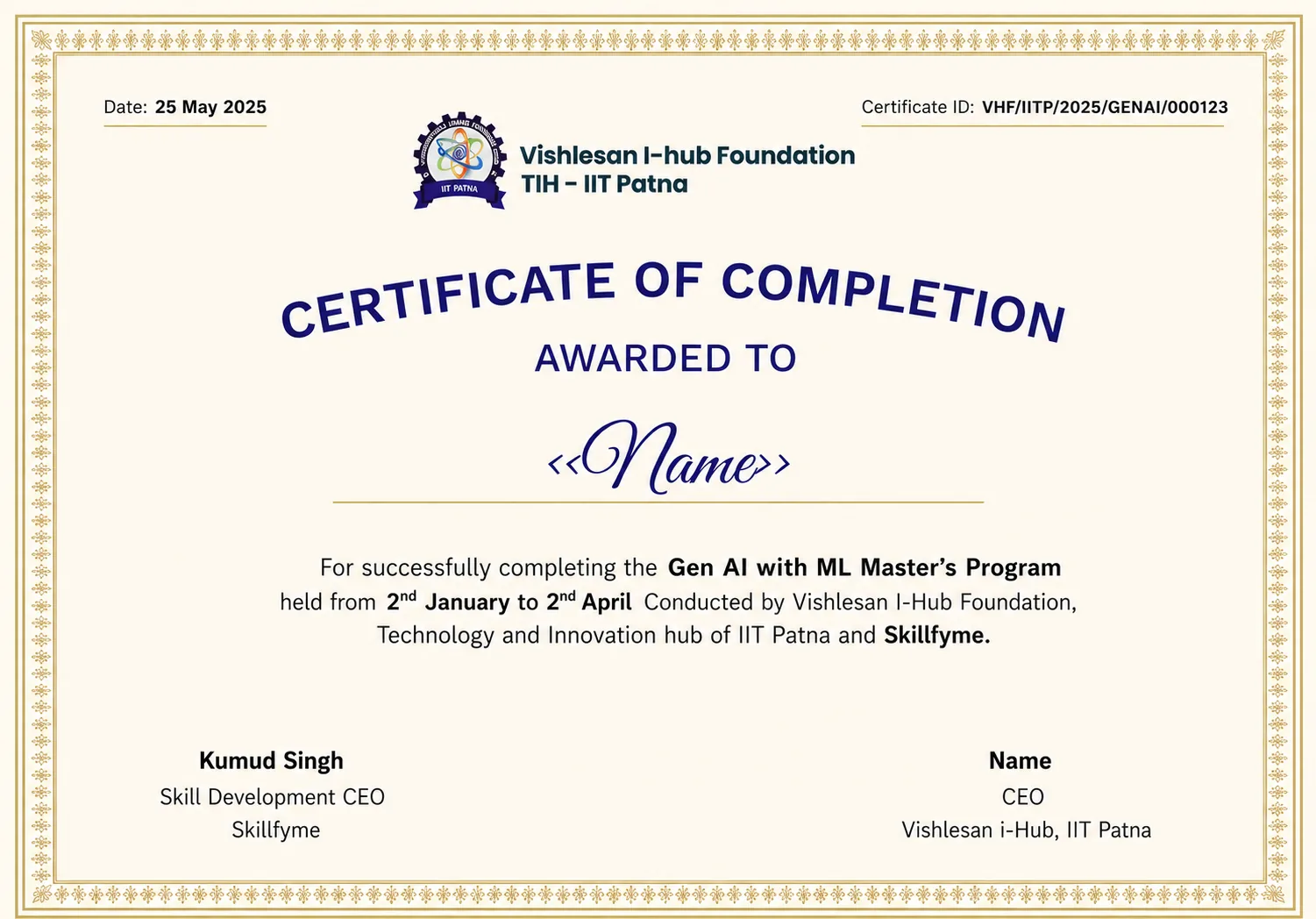
Issued jointly with Vishlesan i-Hub, IIT Patna on completion of the programme and its project work — the same credential for every learner in the cohort, wherever they attend from.
Attending from Pune
The live cohort runs on IST. Pune’s concentration of services employers on fixed shift patterns means the weekend batch is the common choice for working professionals here.
Generative AI course in Pune: frequently asked questions
Is there a generative AI batch in Pune?
Not a separate one. Skillfyme runs a single live online cohort delivered from Bangalore, and learners in Pune join that same cohort rather than a regional batch. There is no Pune classroom and no city-specific start date, which also means there is no local batch to wait for — you join the next national cohort. Classes are live and instructor-led, not pre-recorded, so you can ask questions in real time regardless of where you are.
What does the AI job market in Pune look like?
Services firms and captive engineering centres dominate hiring, so AI roles in Pune more often involve adding intelligence to an existing system than building a greenfield model stack. The automotive and manufacturing presence also means a slice of postings expect comfort with data that arrives from equipment and sensors, where reliability constraints differ sharply from consumer applications. Companies with significant engineering operations in Pune include Persistent Systems, Infosys, Tata Technologies, Cognizant and Bajaj Finserv. The role titles you will most often see advertised locally are Machine Learning Engineer, Data Scientist, AI Engineer and Computer Vision Engineer. This is a description of the local market, not a statement that any named company recruits Skillfyme graduates.
When do classes run for someone working in Pune?
The live cohort runs on IST. Pune’s concentration of services employers on fixed shift patterns means the weekend batch is the common choice for working professionals here. The weekday batch runs for four months and the weekend batch for six, with both covering the identical curriculum — the weekend track spreads the same content over a longer period for working professionals. Sessions are recorded, so a missed class can be caught up.
What does the generative AI training in Pune cover, and how do the classes work?
The generative AI training starts with Python, statistics and machine-learning foundations, then covers large language models, prompt engineering, retrieval-augmented generation (RAG), fine-tuning, agentic AI with LangChain, LangGraph, CrewAI and AutoGen, and MLOps for deploying what you build. Generative AI classes for learners in Pune are live and online: an instructor teaches each session in real time, you build in hands-on labs, and sessions are recorded for catch-up. The projects — an enterprise RAG chatbot and a multi-agent system — are the kind of work Machine Learning Engineer and Data Scientist roles in Pune are hired on. There is no Pune classroom; the same live online classes are attended from every city.
What does the programme cost?
The programme fee is Rs 68,000, currently offered at Rs 50,000, payable in twelve monthly instalments of about Rs 4,167. Pricing is the same wherever you join from — there is no city-specific fee.
What do I need to know before joining?
No prior machine learning experience is required. Python, statistics and machine learning basics are taught in class from first principles, so beginners can start from scratch while experienced engineers treat them as a refresher. The programme suits software engineers, data professionals, analysts moving into AI, and final-year engineering students targeting an AI role.
Does the programme cover agentic AI?
Yes. After the generative AI, large language model and retrieval-augmented generation modules, the curriculum covers agentic AI and multi-agent systems hands-on with LangChain, LangGraph, CrewAI and Autogen, building agents against vector databases such as FAISS, Pinecone and Weaviate. It then continues through MLOps, LLMOps and deployment rather than ending at a demo.
Who issues the certificate?
Certification is issued jointly with Vishlesan i-Hub, IIT Patna — the Technology Innovation Hub at IIT Patna, established under the National Mission on Interdisciplinary Cyber-Physical Systems. It is a professional certification rather than an academic degree: it is not an MS or MSc in generative AI and carries no UGC recognition or academic credit.
What placement support is included?
Placement support covers interview preparation and resume reviews. It is described as support rather than a guarantee, and there is no percentage claim attached to it. Support is the same regardless of which city you join from.