
AI
AI Skills for Software Engineers: What to Learn in 2026
AI is not replacing software engineers. It is replacing the part of the job that was typing known solutions — here are the skills that gain value instead.
The skill that is losing value is producing code you already know how to write. The skills gaining value are deciding what to build, specifying it precisely enough that a model or a junior engineer could execute it, and judging whether the result is actually correct. None of that waits on the next model release. It describes how the work already runs on most teams, which is why chasing each new tool tends to pay less than learning what no tool will hand you.
What actually changed about the job
For most of the last two decades, an experienced engineer’s value was a blend of two things: knowing what to build, and being able to build it. The second half was expensive. It took years to acquire, it was hard to hire for, and it was the reason a senior engineer outproduced a junior one by a wide margin.
Code generation compresses that second half. A competent model will now produce a plausible first draft of a function, a test suite, a migration or a config file faster than you can type it. What it will not do is tell you whether that draft is right for your system, your data, your latency budget or your compliance constraints. The bottleneck moves from production to judgement.
From writing code to directing and reviewing it
More of your day looks like code review, less like authorship. That reads as a demotion to anyone who has not done much reviewing. Sitting with someone else’s code, holding the requirements in your head, and working out whether the two actually meet is slow, unglamorous work — and it is the work senior engineers were always paid for.
Generated code raises the stakes in one specific way: it reads well even when it is wrong. Most human code leaks its own doubt through awkward naming, a hedged comment, a gap someone meant to come back to. You learn to slow down at those spots. A generated function gives you nothing to catch on — it compiles, it looks finished, and it can still be wrong about your edge cases. All the scepticism has to come from you.
Three habits carry most of the weight here:
- State the requirement before you read the answer. If you decide what correct looks like only after seeing the generated code, you will grade it against itself.
- Test the boundaries, not the happy path. Generated code is reliably good at the central case and unreliable at empty inputs, concurrency, partial failure and permissions.
- Refuse to merge what you cannot explain. If you cannot say why a line is there, you have not reviewed it — you have approved it.
The skills worth building now
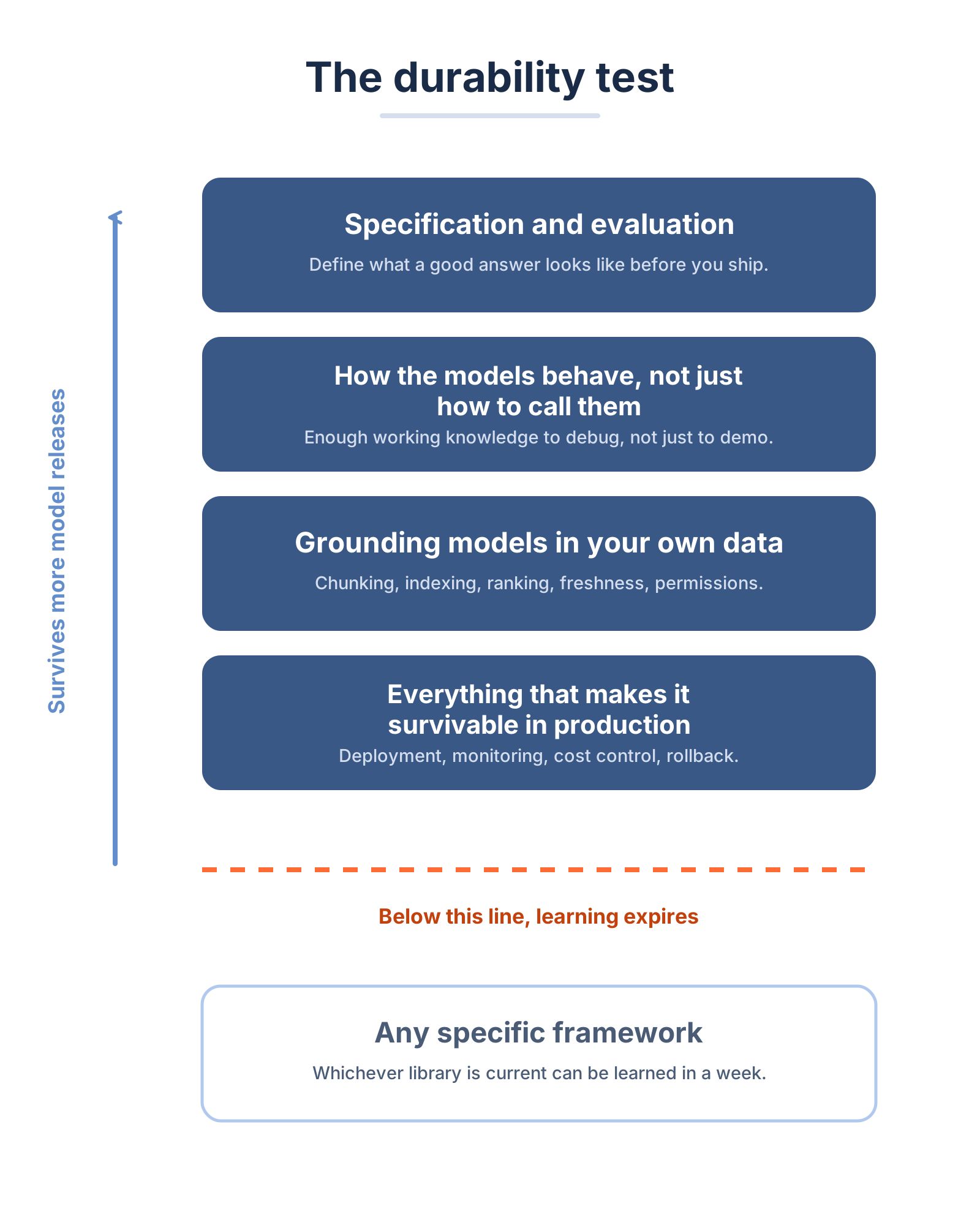
Durability is the filter worth applying: how much of this survives the next model release? Four areas clear that bar.
Specification and evaluation
Stating a problem unambiguously, supplying the right context, and saying what a good answer looks like. Anyone who writes a precise ticket already has most of this, and it works on models, tools and people alike. Evaluation is the other half: decide how you will measure whether an AI feature works before you ship it. “It seems fine” is not a measurement.
How the models behave, not just how to call them
Enough working knowledge to debug: what a context window is and what happens at its edge, why the same prompt returns different answers, why a model fabricates a confident citation, and where the cost and latency actually accumulate. Skip it and you can still get a demo working; what you cannot do is work out why it got worse on Tuesday. If the vocabulary is still fuzzy, our explainer on agentic AI versus generative AI separates the two layers that get used interchangeably.
Grounding models in your own data
Retrieval-augmented generation is the most common production requirement in real organisations, because the valuable questions are about internal data a general model has never seen. The engineering content is familiar — chunking, indexing, ranking, freshness, permissions — which is precisely why experienced engineers pick it up quickly.
Everything that makes it survivable in production
Deployment, monitoring, cost control, prompt-injection and data-leakage risk, and a rollback story for the day a model provider changes behaviour underneath you. This is ordinary systems engineering applied to a component that is non-deterministic, and it is where most experienced engineers already have transferable ground.
How to approach the transition
Two honest cautions. First, using AI tools well in your existing job and building AI features are different skills; the first takes weeks of deliberate practice, the second is a longer arc. Second, seniority does not transfer automatically — a fifteen-year backend engineer is a beginner at evaluation, and pretending otherwise is the most common way the transition stalls.
Structure mostly helps by forcing the unglamorous parts — evaluation, deployment, monitoring — that nobody schedules for themselves after the demo works. If you are weighing a programme, our guide to choosing an agentic AI course lists the questions worth sending to any provider before you pay.
This article deliberately stops at what to learn rather than when. If you want the same ground as a sequence — what to build first, and what to be able to show at the end of each stage — our six-month plan for becoming an AI-native engineer sets the order out month by month.
Frequently asked questions
Will AI replace software engineers?
One activity is going away, and the role is not it. First drafts — a function, a test file, a migration script — are cheap now. Working out what to build, catching the draft that quietly does the wrong thing, and answering for it once it is in production have not moved at all. Engineers whose value sat mostly in typing out known solutions will feel this. Engineers who can pin down a problem and pull apart an answer will not.
What AI skills should a software engineer learn first?
Reviewing generated code as hard as you would review a colleague’s — that is the one you will use every day, so start there. Next, enough of how the models work to debug them: context windows, tokenisation, why a model invents a citation, why the same prompt lands differently twice. Retrieval-augmented generation after that, since grounding a model in your own data is what most production work turns out to need. Frameworks last. They churn faster than anything underneath them.
Do I need machine learning maths to work with generative AI?
To build applications on top of models, no — you need to understand behaviour, not derive backpropagation. To evaluate models, tune them, or debug why a fine-tune degraded, yes, you need the underlying maths. Most engineers moving into GenAI work start in the first category and grow into the second. Be honest about which one your target role requires before choosing how deep to go.
Is prompt engineering still a useful skill?
The job title was always shaky. The skill underneath is now assumed, roughly the way writing a decent bug report is assumed: state the problem unambiguously, supply the right context, say what a correct answer looks like. That carries across model releases. A memorised bag of tricks for one model version does not.
How do I stay relevant when models keep improving?
Anchor your learning to whatever changes slowly. Which model leads this quarter will not matter next year; system design, evaluation, data handling, security and cost control will still be there. Define what "good" means for an AI feature, measure it, and keep it working under real traffic, and it stops mattering much which model is currently ahead.
How long does it take to become productive with GenAI engineering?
Using AI tools well in your existing job is a matter of weeks of deliberate practice. Building and shipping AI features — retrieval, evaluation, deployment, monitoring — is a longer arc, and is what a structured programme is for. Skillfyme’s Generative AI with ML Masters Program runs four months on weekday batches or six months on weekend batches, live and instructor-led.
Next steps
Pick one real problem in the system you already own and build the whole path for it: specify it, ground a model in your own data, define how you will measure success, then deploy and watch it. One end-to-end feature teaches more than a dozen tutorials, because only the full path forces you through evaluation and operations.