
AI
From Software Engineer to AI-Native Engineer: A 6-Month Plan
Which parts of an engineering job AI is repricing, what an AI-native engineer actually does daily, and a month-by-month 6-month plan with what to build.
An AI-native engineer is not an engineer who uses AI tools to write code faster. It is an engineer who can design, evaluate and operate a system that has a non-deterministic component inside it — and who can prove the thing works before it reaches a customer.
Most engineers who say they “use AI daily” mean autocomplete. Very few can answer the question a hiring manager actually asks, which is: how did you know it was correct?
If you are still at the “is my job safe” stage, the short version is that code production is being repriced while judgement is not, and we argued that properly in AI skills for software engineers. This post assumes you want the sequence. It is how to future-proof a software engineering career with evidence rather than reassurance.
What is actually at risk, in one pass
Sort your own week into three buckets. This is the input to the plan, not a debate.
| Bucket | Examples | Direction |
|---|---|---|
| Repricing fast | Boilerplate, CRUD endpoints, test scaffolding, config, first-draft migrations | Still needed, worth less as a differentiator |
| Holding value | Debugging production, system design, review, requirement translation | Unchanged |
| Appreciating | Evaluation, grounding models in private data, cost and latency control, failure design for non-deterministic components | Scarce, and priced accordingly |
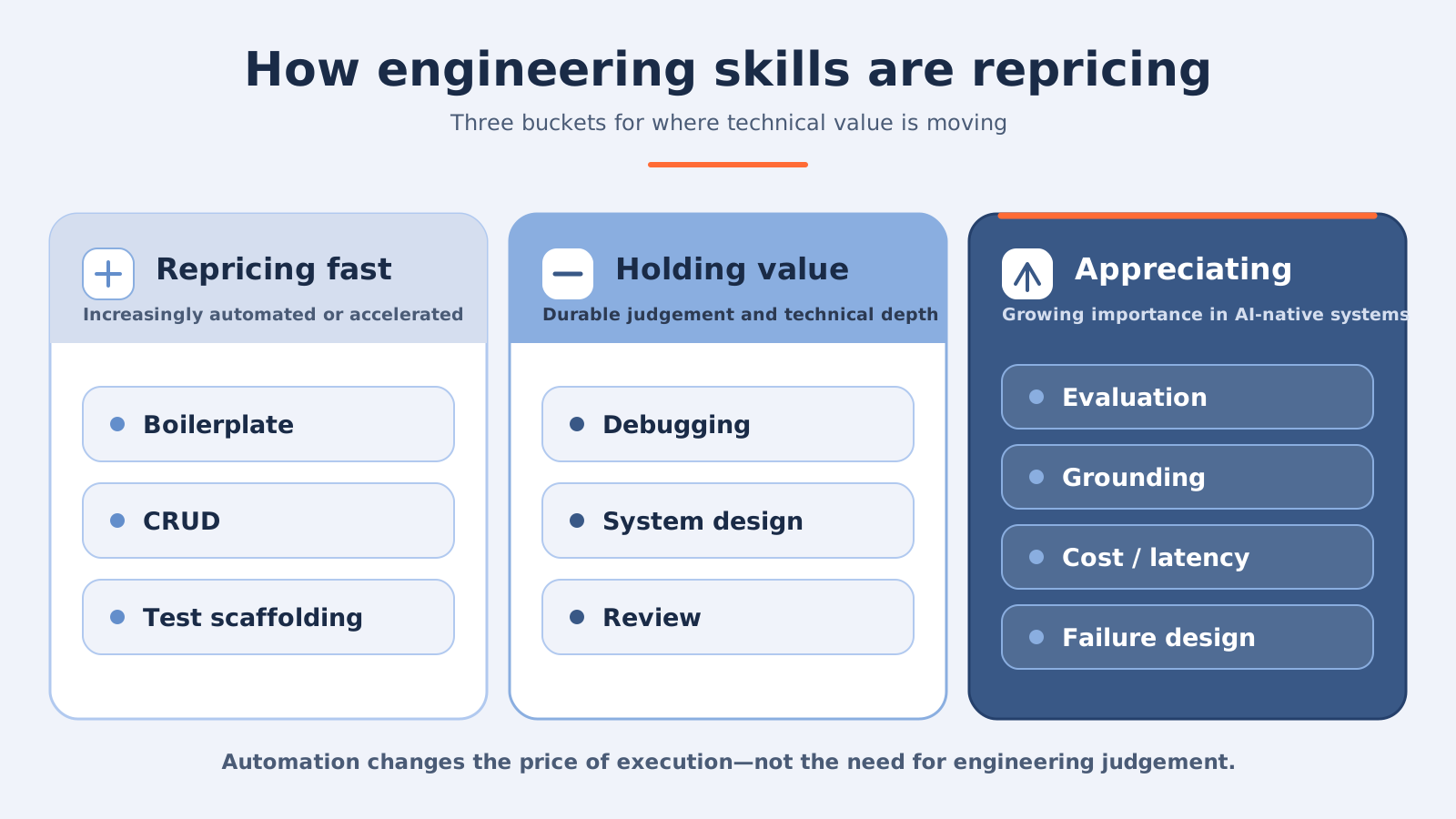
The trap is bucket one. Plenty of engineers with eight years of experience have a week that is mostly bucket one, and they read their seniority from their job title rather than from their week. Count honestly.
What an AI-native engineer does on a Tuesday
Forget the skills list. Here is the shape of the work.
They spend more time writing evaluation cases than prompts. A prompt takes ten minutes; deciding what “good output” means for 200 real user inputs takes days, and it is the artifact the team depends on.
They treat the model as an unreliable network dependency. It has latency, it has cost per call, and it fails plausibly — returning something well-formed and wrong. So they build what you build around any flaky dependency: timeouts, fallbacks, caching, a kill switch, and a dashboard showing what it did last night.
They own data plumbing they did not expect to own. Most production AI work is retrieval: chunking documents, indexing them, keeping the index fresh, and — the part that sinks projects — making sure nobody retrieves a document they were never allowed to read. That last one is an access-control problem wearing an AI hat.
And they can say why a change made things better. Not “it feels sharper now.” A number, against a fixed test set, before and after.
Notice what is missing: nobody there is prompting more cleverly than you.
The 6-month plan
Assume 6–8 hours a week alongside a full-time job. That constraint is why this is six months rather than six weeks. Each stage produces one artifact you can show someone, and if a stage ends without its artifact, repeat it — the schedule is not the point.
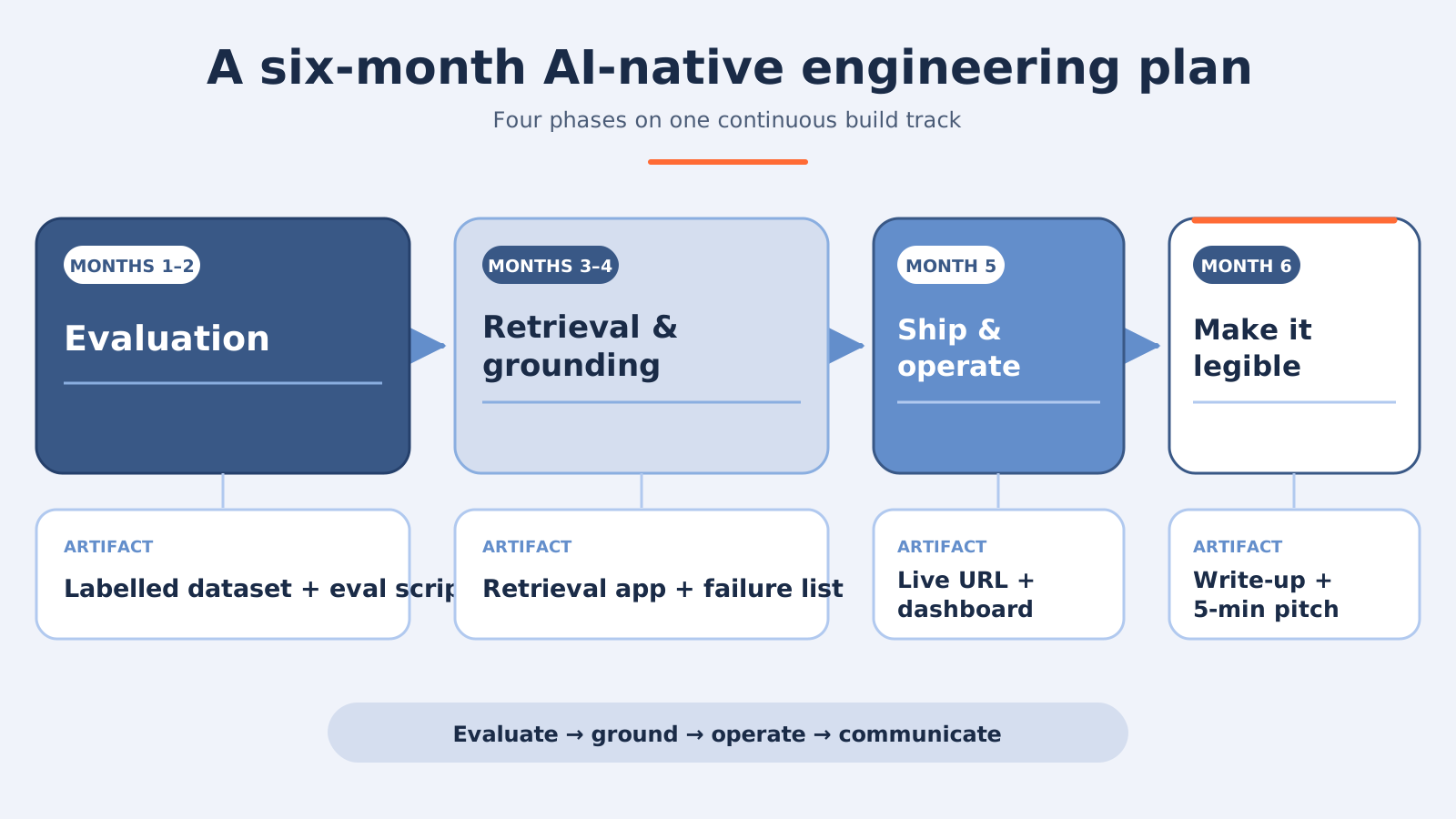
Months 1–2: evaluation first. Counter-intuitive, and the reason most self-taught transitions stall. Take one task you can define narrowly — classifying support tickets, extracting fields from invoices, summarising a specific document type. Hand-label 100–200 real examples. Build a script that runs a model over them and scores the output against your labels. Then change one thing (the prompt, the model, the input format) and watch the score move. Artifact: a repo with a labelled dataset, an eval script, and a short README stating what score you started at and what you got to. Unglamorous, and the thing most portfolios skip straight past on the way to a demo.
Months 3–4: grounding and retrieval. Point the same kind of system at data a general model has never seen — your own notes, your company’s public docs, a dataset you can legally use. Build the full path: chunk, embed, index, retrieve, answer. Then break it deliberately. Ask it something the documents do not contain and see if it invents an answer. Add a document and check whether it appears in results. Put two users with different permissions in front of it. Artifact: a working retrieval app, plus a written list of the failure cases you found and what you changed. In an interview the failure list is worth more than the app.
Month 5: ship it and operate it. Deploy somewhere real, behind auth. Log every request, response, token count and latency. Set a cost alert. Write the rollback step. Run it three weeks and read the logs — you will find inputs you never imagined, which is the lesson. Artifact: a live URL, a dashboard screenshot, and one paragraph on what surprised you in the logs.
Month 6: make it legible. Write up the whole thing: the problem, the eval design, the numbers, what broke, what it costs per 1,000 requests. Rewrite your CV around it. Then practise saying it out loud in five minutes, because you will be asked. Artifact: a public write-up and a five-minute verbal version.
Engineers skip month 6 because it is not engineering. It is the month that converts the previous five into offers.
Proving it — the evidence that actually gets checked
An interviewer cannot verify “experienced with LLMs.” They can verify these:
- A number with a method. “Accuracy went from 71% to 88% on a 200-example set I labelled myself” invites a real conversation. “Significantly improved” ends one.
- A failure you found and fixed. Especially a retrieval permissions leak, a prompt injection, or a plausible-but-wrong output your eval caught.
- A cost figure. Per request, or per 1,000. Anyone who has owned an AI budget knows instantly whether you have looked.
- A decision you reversed. “We used a bigger model, then found a smaller one scored the same on our set for a fraction of the cost.”
Two of those four are operational, not modelling. That is where the shortage is.
The India-specific read
AI hiring demand in India is not evenly distributed, and picking the wrong path wastes months.
Indian AI talent demand is projected to grow from 600,000–650,000 to more than 1,250,000 across 2022–27, per the Deloitte–NASSCOM report published in August 2024. Treat that as direction, not a promise about your city or your stack — it was projected before the current agentic wave, and I found no verified 2026 update with comparable methodology.
What is observable without a statistic: services firms and GCCs are the volume buyers, and they buy differently from product startups. Their work carries client-defined review and audit obligations, which makes evidence of process — how output was evaluated and approved — commercially valuable rather than internal hygiene, a dynamic we worked through in the AI-native SDLC. Product companies buy the model-application path instead: retrieval, evaluation, latency, unit economics.
Pick whichever your employer resembles. Only the dataset in months 3–4 changes.
Which path, and where structure helps
The six-month plan leads to two genuinely different jobs.
If you own infrastructure, pipelines or reliability, the platform path is the shorter walk. You already have deployment, monitoring and rollback; you are adding a non-deterministic component and the governance around it — DevOps with AI.
If you build product features and want the model side — retrieval, evaluation, fine-tuning, agent design — that is GenAI with ML.
You can do all six months alone, and some people should. Structure earns its cost in exactly one way: it forces the unglamorous months. Almost everyone teaching themselves skips evaluation and operations, because the demo already works and nobody is waiting on the write-up.
Not sure which path your experience maps to? Bring your week’s bucket count to a counselling call — that is the question worth an hour of someone else’s time.
Frequently asked questions
How long does it take to become an AI-native engineer?
For a working software engineer with production experience, roughly six months at 6–8 hours a week: about two months building evaluation habits, two months on retrieval and grounding, and two months shipping, operating and documenting one real feature. Engineers who already own deployment and monitoring tend to move faster through the final two.
Do I need a machine learning degree to become an AI-native engineer?
No. Most production AI work is systems work — retrieval, evaluation, access control, latency and cost — applied to a component that behaves non-deterministically. Training models from scratch is a separate specialisation. The maths becomes necessary if you move into fine-tuning or model research, not for building and operating AI features.
Is an AI-native engineer the same as a prompt engineer?
No. Prompting is one small input to the work. An AI-native engineer is accountable for whether the system is correct, affordable and operable in production — which means evaluation sets, retrieval quality, permissions, monitoring, fallbacks and cost per request. Prompt quality matters, but it is not the deliverable.
What should I build first if I have no AI experience?
Build an evaluation harness before building an application. Pick one narrow task, hand-label 100–200 real examples, and write a script that scores model output against those labels. Starting here rather than with a demo means you can answer the question that decides an AI feature’s fate — whether it is actually correct — instead of only whether it looks right.
Will AI replace software engineers?
The part being repriced is producing code someone already knows how to write. The parts holding or gaining value are deciding what to build, specifying it precisely, and judging whether the result is correct — which is why the shortage is in evaluation and operations rather than in code generation.