
AI
Generative AI with ML: What You Actually Need to Learn to Get Hired in 2026
A GenAI with ML course is worth the fee only if it teaches both halves: training models and shipping systems around them. What to learn, and how long.
Most GenAI job descriptions in India now ask for two things that used to sit in different roles: the ability to train and evaluate a model, and the ability to build a reliable system around a model someone else trained. A GenAI with ML course is worth its fee only if it teaches both, because the first without the second produces someone who can fine-tune but not ship, and the second without the first produces someone who can call an API but cannot say why the output degraded.
Competition for those jobs is the reason the distinction matters. India recorded 3.6 million GenAI course enrolments in 2025, the highest of any country, according to Coursera’s reporting on its own platform. Enrolment is not employment. A course that leaves you interchangeable with a few million other certificate holders has not done the job, which is why the curriculum question is worth more attention than the brand on the certificate.
Traditional ML skills vs GenAI skills: what employers hire for
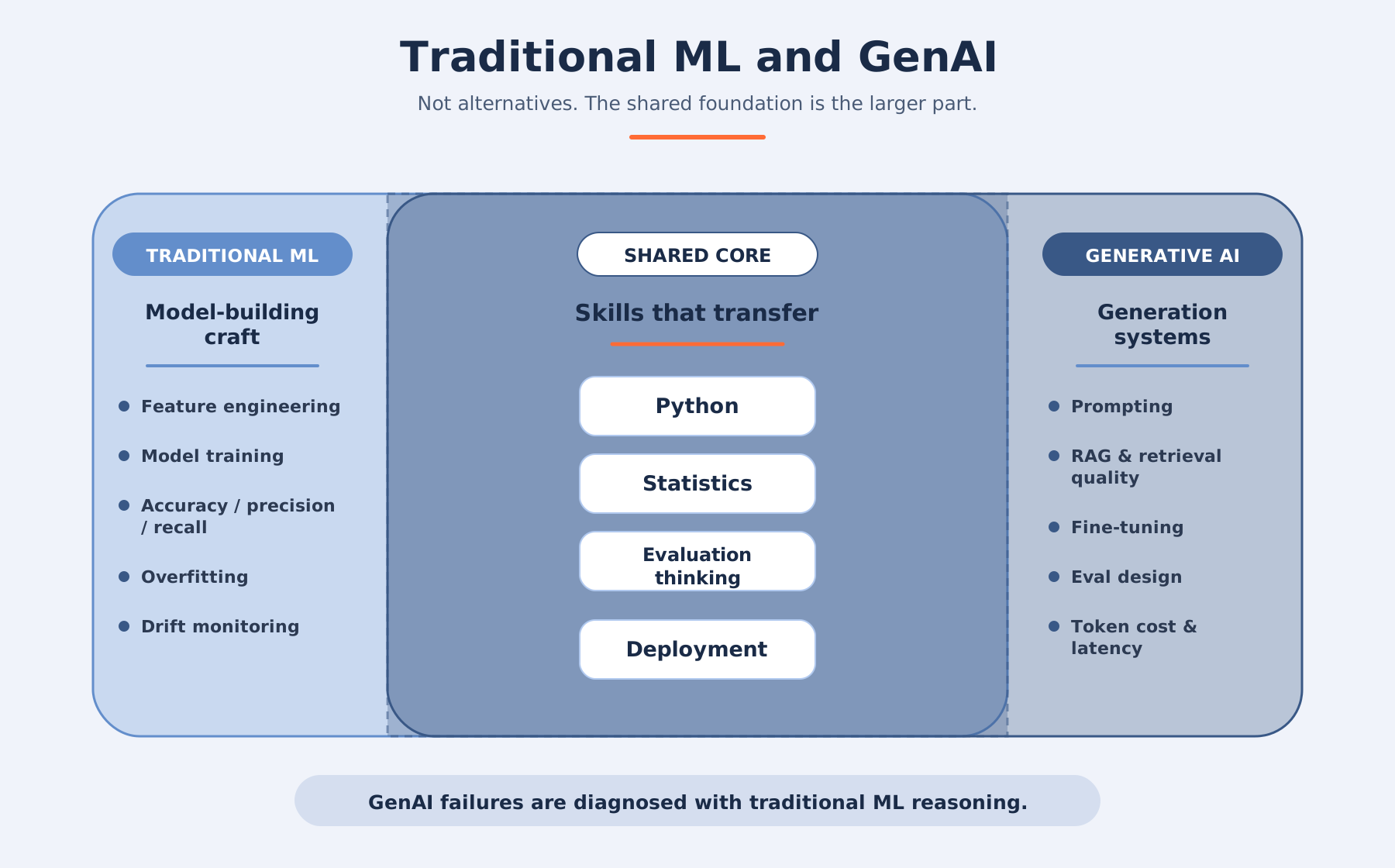
Traditional ML skills are about producing a model: feature engineering, choosing an algorithm, training, tuning, and measuring accuracy against a labelled test set. GenAI skills are about controlling a pre-trained model you did not build: prompting it, grounding it in your own data through retrieval, fine-tuning it on a narrow task, evaluating outputs that have no single correct answer, and keeping cost and latency inside a budget.
The word “versus” oversells the conflict. The reason job ads ask for both is that GenAI work breaks in ways only ML fundamentals explain. A retrieval system returning irrelevant chunks is an embedding and similarity-metric problem. A fine-tuned model that got worse is overfitting, with a new name. An evaluation suite that says your chatbot improved when users say it did not is a metrics-design problem that predates transformers by decades.
What changed is where the effort goes: less training from scratch, far more evaluation, retrieval quality and deployment. For the broader career picture — which parts of software work are gaining and losing value — see AI skills for software engineers. This article stays on what to learn, and in what order.
| Area | Traditional ML | GenAI |
|---|---|---|
| Core artefact | A model you trained | A model you adapted and grounded |
| Data work | Labelling, feature engineering | Chunking, embedding, retrieval quality |
| Evaluation | Accuracy, precision, recall on a test set | Task-specific evals, human review, groundedness |
| Main failure | Overfitting, data leakage | Hallucination, stale retrieval, cost blowout |
| Deployment | Model serving, drift monitoring | Same, plus prompt versioning and token cost |
Note the last row. MLOps did not get replaced; it grew a second half.
Which GenAI tools are worth learning, and which are hype
The durable skills are the concepts, not the libraries. Retrieval-augmented generation, embeddings and vector search, fine-tuning, agent design, and evaluation will outlive the specific packages that currently implement them. Learn a tool as a way of learning a concept and the next framework takes a weekend. Learn a tool as a product and you are back at the start whenever it is superseded.
Worth the time, because they teach something transferable:
- Python, plus a working grasp of statistics and classical ML. Every layer above assumes it.
- Transformers and the Hugging Face ecosystem, for actually loading, fine-tuning and running models rather than reading about them.
- RAG with a real vector store — FAISS, Pinecone, Weaviate or Milvus. Which one you pick matters far less than understanding chunking strategy, embedding choice and retrieval evaluation.
- One agent framework, such as LangGraph, CrewAI, Phidata or Autogen, learned deeply enough to know what it is doing underneath. The distinction between generative and agentic systems is worth getting straight before you pick one; generative AI vs agentic AI covers it.
- LLMOps and deployment: versioning prompts, monitoring cost and latency, catching quality regressions.
Where people waste months: collecting framework names without shipping anything with them, chasing every new model release as though the skill were the model, and treating prompt engineering as a standalone career. Prompt engineering is a real technique and a thin job. Memorising a new agent library every quarter is not a skill either — the underlying loop of plan, call a tool, observe, decide has been stable for a while now, and it is that loop employers are testing you on.
One honest caveat: which frameworks dominate two years from now is not something anyone can tell you, including any course brochure. That uncertainty is the argument for depth over breadth, not against learning tools at all.
How long it realistically takes to become job-ready from a non-AI background
Realistically, six to nine months of consistent part-time study, if you already write code. The structured teaching is the shorter part; the portfolio you build alongside it is what takes the time and what gets you interviews.
That estimate assumes a working software background — you are comfortable with Python or can get there quickly, and you have shipped something to production before. Coming from a non-technical role, expect longer, with most of the extra time going into programming and statistics before any of the GenAI material makes sense.
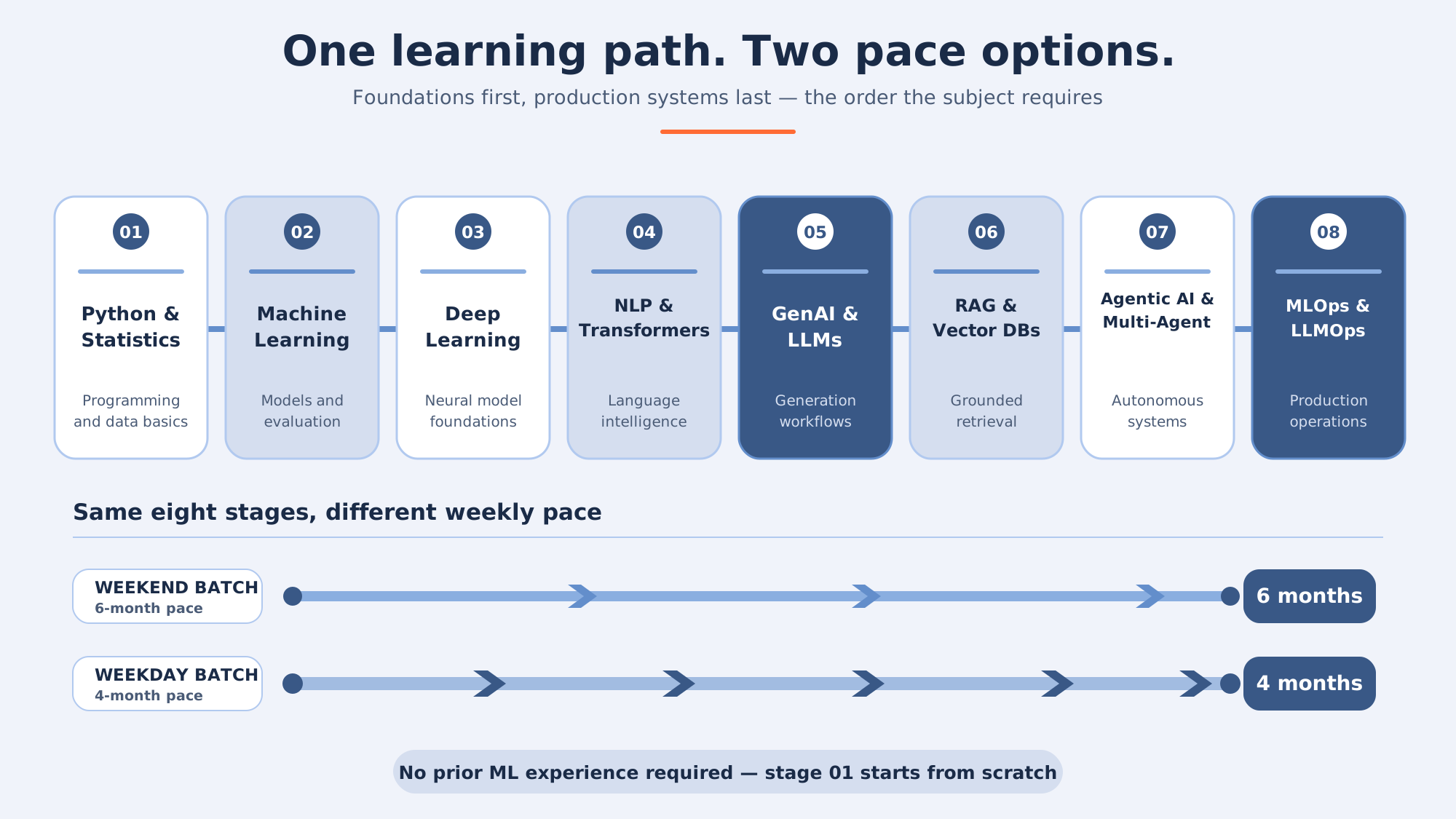
Skillfyme’s GenAI with ML Masters Program runs 6 months in the weekend batch or 4 months in the weekday batch. No prior ML experience is required: Python, statistics and ML basics are taught in class, so beginners start from scratch while experienced engineers use them as a refresher. The sequence runs from Python and statistics foundations through machine learning, deep learning and NLP with transformers, into generative AI and LLMs, RAG and vector databases, agentic and multi-agent systems, and finishes with MLOps, LLMOps and deployment.
The programme fee is ₹68,000, currently offered at ₹50,000, payable in twelve monthly instalments of about ₹4,167. It is a professional certification programme, not a university MS or MSc — selected cohorts run with IIT Patna’s Vishlesan i-Hub, which issues joint certification.
Treat any course duration as the floor, not the finish line. The batch ends when the syllabus ends; you are job-ready when you can explain a system you built, including where it failed and what you changed. If you are weighing a GenAI programme against an agent-focused one, the agentic AI course comparison sets out the differences.
Frequently asked questions
Do I need machine learning experience before a GenAI with ML course?
No. A GenAI with ML course that starts from Python, statistics and ML fundamentals does not assume prior ML experience — Skillfyme’s programme teaches those in class. You do need to be comfortable programming, or willing to put in extra weeks on Python before the ML material begins.
Is a GenAI with ML course the same as a master’s degree in AI?
No. Skillfyme’s Generative AI with ML Masters Program is a professional certification programme, not a university MS or MSc in generative AI. "Masters Program" is the product name. Selected cohorts run with IIT Patna’s Vishlesan i-Hub, which issues joint certification.
Should I learn traditional machine learning first, or go straight to GenAI?
Learn them together, with ML first in sequence. GenAI failures — poor retrieval, degraded fine-tuning, misleading evaluation metrics — are diagnosed with traditional ML reasoning. Skipping the fundamentals means you can build a demo but cannot fix it when it breaks in production.
How much does the Skillfyme GenAI with ML course cost?
The programme fee is ₹68,000, currently offered at ₹50,000, payable in twelve monthly instalments of about ₹4,167.