
DevOps
AIOps in DevOps: What AI Agents Actually Do in a Pipeline
What AIOps means in a DevOps pipeline: where AI agents genuinely fit, what breaks in practice, and the skills worth building before the tooling turns over.
AIOps means applying models to operational data — anomaly detection on metrics, log clustering that collapses a thousand alerts into one, signal correlation during an incident, forecasting load before it arrives. It runs on the telemetry your monitoring already produces. Which is why the teams who get the least from it are usually the ones whose observability was thin to begin with. The models have nothing good to read.
What AIOps actually means
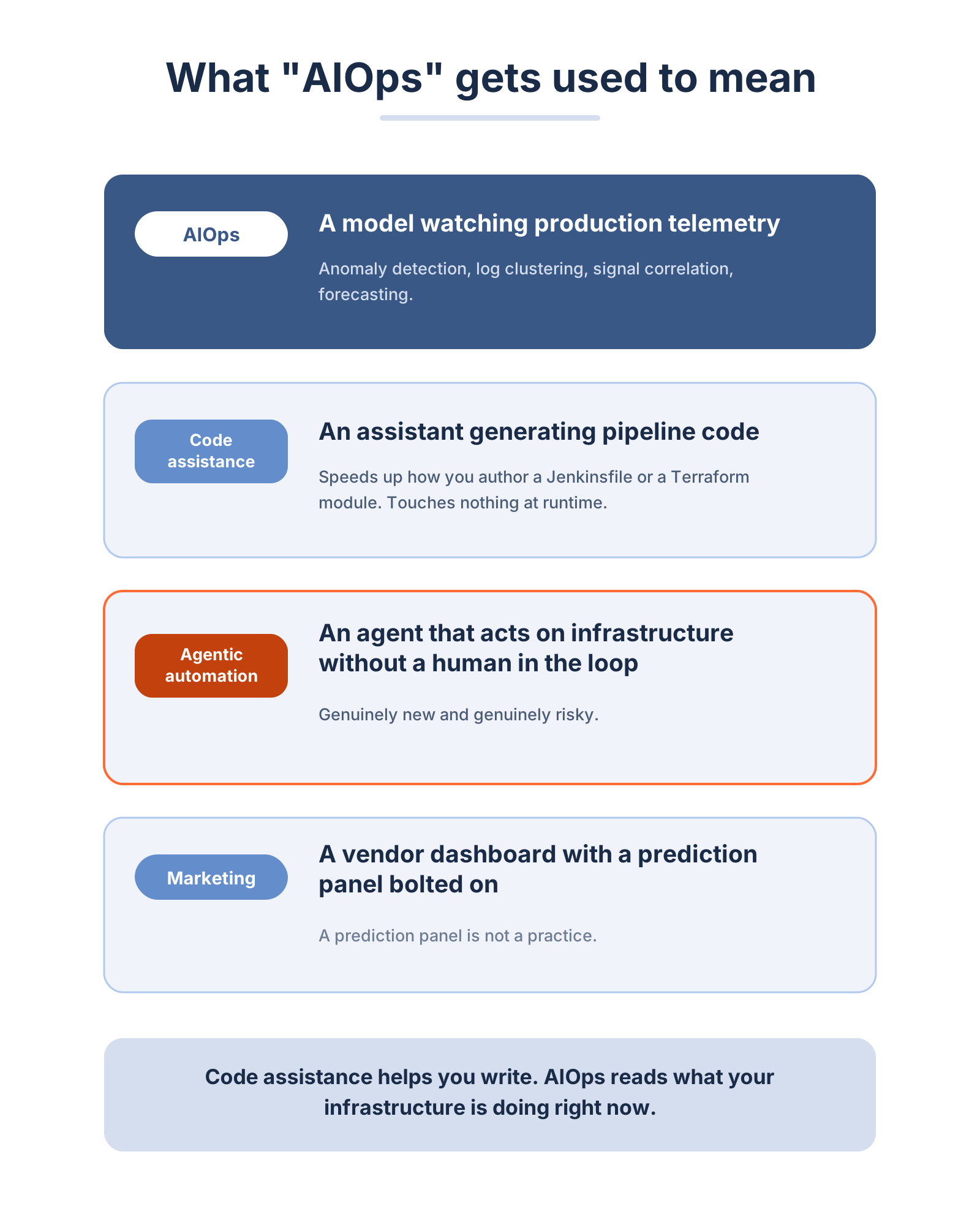
The term gets stretched across four different things, and separating them is most of the battle. Someone says “we’re doing AIOps” and could mean any of: a model watching production telemetry, an assistant generating pipeline code, an agent that acts on infrastructure without a human in the loop, or a vendor dashboard with a prediction panel bolted on.
Only the first is AIOps in the original sense. The second is code assistance, which speeds up how you author a Jenkinsfile or a Terraform module and touches nothing at runtime. The third is agentic automation, genuinely new and genuinely risky. The fourth is marketing.
For where this sits inside a curriculum, our breakdown of what a DevOps course includes places AIOps after the observability module, for the reason above: it operates on data that module produces.
Where agents sit in a pipeline
Strip the vocabulary away and an agent in a pipeline does four things: it observes state, decides an action is warranted, performs it, and reports what it did. Every one of those steps already exists in your automation. What changes is that the decision step stops being a rule you wrote and becomes a judgement something else made.
In practice the useful placements are narrow and boring, which is a good sign:
- Triage before the page. Correlating a spike across metrics, logs and recent deploys, then attaching that context to the alert so whoever wakes up starts with a hypothesis.
- Noise reduction. Collapsing correlated alerts into one incident. Unglamorous, and probably the highest-value thing on this list.
- Bounded remediation. Restarting a known-bad pod, scaling against a forecast, rolling back a deploy whose error rate crossed a line you set.
- Change risk scoring. Flagging a pull request as higher-risk based on what it touches and what broke last time something similar shipped.
Notice none of those is “the agent runs the pipeline”. Each is a specific decision, inside a boundary, with a defined blast radius. That framing is what makes the difference between a system you can operate and a system you are hostage to.
What breaks in practice
Three failure modes show up repeatedly, and none of them is exotic.
The data was never good enough
Anomaly detection on metrics nobody instrumented properly produces confident nonsense. Point log clustering at five services that each log in their own shape and it will happily surface the formatting differences as a pattern. Fix the telemetry first. Unglamorous work, and the entire foundation.
False positives burn the trust fast
An anomaly detector that pages twice a week for nothing gets muted within a month, and once muted it stays muted. Call that a social failure more than a technical one. The model was likely working as designed; someone tuned the threshold for recall, and the on-call rotation paid for it.
Nobody defined the blast radius
The dangerous configuration is an agent with production credentials and a vague mandate. Before anything acts unsupervised, three questions need answers: what exactly may it do, what is the maximum damage if it acts on a bad signal, and how fast can a human stop it. Leave any of the three unanswered and the agent has no business acting on its own.

What to learn
Prioritise by what stays true when the tooling turns over. None of it is new ground: monitoring and feedback is already one of the seven DevOps pillars, and AIOps is what happens when a model is pointed at the data that pillar produces rather than a replacement for it.
Observability, properly. Instrumentation, structured logging, metrics that carry meaning, traces that survive a service boundary. Everything else reads from this layer, and no model compensates for its absence.
How models behave on operational data. Why a detector raises false positives, what seasonality does to a baseline, why a model trained on last quarter degrades quietly after an architecture change. Enough to distrust the output at the right moments.
Guardrails for anything that acts. Scoped permissions, blast radius, rollback paths, audit trails, and a clear answer to who is accountable when an automated action goes wrong. This is ordinary systems engineering pointed at a non-deterministic component, and it is where experienced DevOps engineers already have ground to stand on.
If a structured programme suits you better than self-study, our guide to choosing a DevOps course covers the questions worth sending to any provider before you pay.
Frequently asked questions
What is AIOps?
AIOps means applying models to operational data: spotting anomalies in metrics, clustering logs so a thousand alerts collapse into one, correlating signals during an incident, and forecasting load before it arrives. It runs on the telemetry your monitoring already produces, which is why teams without solid observability get very little from it. The data has to exist and be trustworthy first.
Is AIOps the same as using AI to write pipeline code?
No, and conflating them causes most of the confusion. Generating a Jenkinsfile or a Terraform module is code assistance — it helps you author something faster. AIOps operates on running systems: it reads what your infrastructure is doing right now and draws conclusions about it. One speeds up your writing. The other watches production.
Will AI agents replace DevOps engineers?
An agent can already open a pull request, roll back a deploy, or scale a service against a rule you set. What it cannot do is carry the consequence. Someone still decides what the system is allowed to do unsupervised, what happens when it acts on a bad signal, and who gets paged when it does. That judgement is the job, and it has not moved.
What should a DevOps engineer learn to work with AIOps?
Observability first, because everything downstream reads from it: instrumentation, structured logs, metrics that mean something, traces that connect across services. Then how the models behave on operational data, particularly why they raise false positives and what that does to on-call trust. Then the guardrails — permissions, blast radius, rollback, audit trails — for anything allowed to act on its own.
Do I need to be a data scientist to work with AIOps?
To use and operate these systems, no. You need to read what a model is telling you, know when to distrust it, and design the safety net around it. To build detection models from scratch you do need the statistics. Most DevOps engineers start in the first category and stay there productively for a long time.
How does Skillfyme cover AIOps?
The DevOps with AI Masters Program integrates AI and AIOps into the pipeline modules rather than appending them as a standalone block at the end, so the AI content applies to workflows you have already built. It runs three months on the weekday batch or six on the weekend batch, live and instructor-led, with joint certification from Vishlesan i-Hub, IIT Patna.
Next steps
Take one alert your team currently ignores and work out why it fires. Usually the answer is a threshold set once and never revisited, or a service logging in a shape nothing else can parse. Fixing that single alert teaches more about AIOps than any tool evaluation, because the work is identical to what the models need done before they are worth pointing at anything.