
DevOps
What Does a DevOps Course Include?
What a DevOps course includes: Linux, Git, Docker, Kubernetes, Terraform, Ansible, CI/CD, cloud and monitoring — the nine modules, in the order they must be taught.
A DevOps course includes nine core components: Linux and shell scripting, Git and version control, Docker containers, Kubernetes orchestration, infrastructure as code with Terraform, configuration management with Ansible, CI/CD pipelines, cloud platform fundamentals, and monitoring and observability. Most curricula add security practices, hands-on labs and a capstone project that deploys a real application end to end.
The nine components of a DevOps curriculum
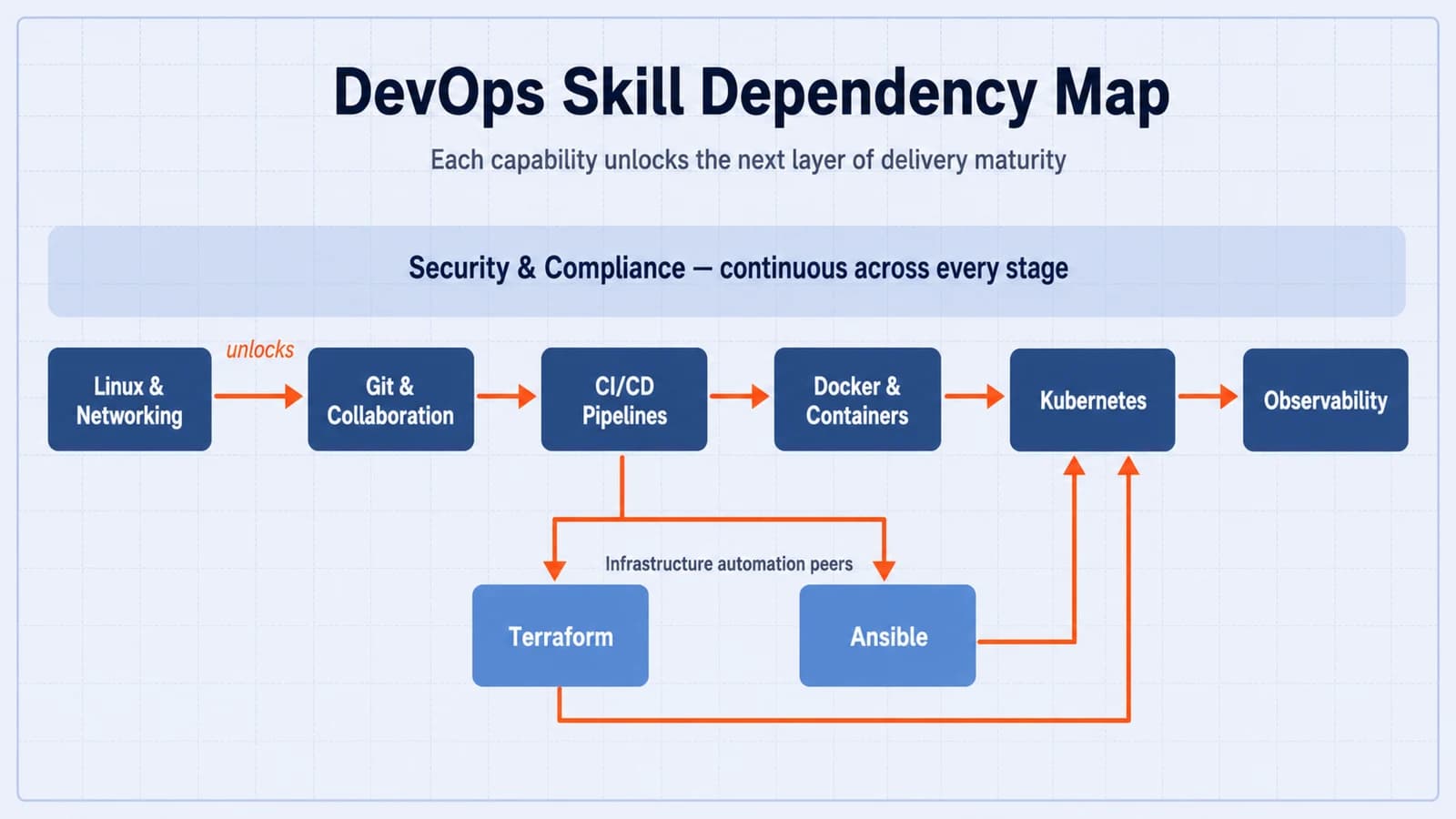
Here is the full inventory, in the order a curriculum has to teach it. The diagram below maps the same nine components as a dependency graph rather than a teaching sequence — CI/CD appears earlier there because it is what every other module ultimately feeds, and Terraform and Ansible appear as parallel automation peers rather than as consecutive steps. The third column is the part most syllabi leave out: what the module actually unlocks.
| # | Component | Core tools taught | What it unlocks |
|---|---|---|---|
| 1 | Linux and shell scripting | Bash, filesystem, permissions, processes, systemd, SSH | Everything. Containers, pipelines and cloud instances are all Linux underneath |
| 2 | Version control | Git, GitHub or GitLab, branching strategies, pull requests | The trigger and the source of truth for every pipeline built later |
| 3 | Containers | Docker, images, registries, Dockerfiles, volumes, networks | The unit of deployment that orchestration schedules |
| 4 | Container orchestration | Kubernetes: Pods, Deployments, Services, ConfigMaps, scaling, rollouts | Running containers across many machines with self-healing and rollout control |
| 5 | Infrastructure as code | Terraform, HCL, state, plan and apply, modules, drift | Creating the cloud infrastructure the cluster and pipeline run on, reproducibly |
| 6 | Configuration management | Ansible, inventories, playbooks, roles, idempotency | Configuring servers and applications after provisioning creates them |
| 7 | CI/CD | Jenkins, GitHub Actions, build/test/deploy stages, artifacts, deployment strategies | The automation that connects every previous module into one delivery path |
| 8 | Cloud platform | AWS or Azure: IAM, compute, storage, networking, managed Kubernetes | The environment the whole toolchain runs in, and the cost and access model around it |
| 9 | Monitoring and observability | Prometheus, Grafana, metrics, logs, traces, alerting | Knowing whether a deployment actually worked, and finding out why when it did not |
Two things appear across all nine rather than as separate blocks in a well-built syllabus: security, which belongs inside the pipeline rather than after it, and hands-on labs, which is where each module is actually learned.
The same caveat applies one level up. The principles a curriculum is built to teach have no official list either — the same author has published both a seven-pillar and a nine-pillar version, which is why the 7 pillars of DevOps need sorting out from the 7 C’s and the lifecycle phases — worth reading alongside this inventory if you want the ideas the nine modules exist to deliver rather than the tools themselves.
Why the order matters more than the list
The order of a DevOps syllabus tells you more about its quality than the list of tools does, because each module is the prerequisite for the next. Containers are Linux processes with namespaces and cgroups around them, so Docker taught before Linux produces a learner who can run docker run and cannot diagnose why the container exits immediately. Kubernetes schedules containers, so it is not teachable before containers exist as a concept. CI/CD automates the git-to-deployment path, so it needs both a repository and a deployment target to be more than YAML recitation.
This is why a tool count is a poor quality signal and a dependency chain is a good one. A syllabus advertising eighteen tools and a syllabus teaching nine can easily deliver the same total hours — the difference is depth per tool.
That arithmetic is worth doing explicitly, because it is the most useful thing a reader can do with any syllabus in front of them. One of the commercial curricula read for this article lists 18 modules across roughly 90 taught hours. Divided evenly, that is under five hours per module. Five hours is enough to install a service mesh and follow a tutorial. It is not enough to understand when a service mesh is the wrong answer. Take the total taught hours of any syllabus, divide by the module count, and ask whether the resulting number is exposure or competence. Both are legitimate — a survey course has value — but they are different products and the module count alone will not tell you which one you are reading.
The Linux test. Of the two commercial syllabi read in full for this article, one contained 18 modules and no Linux module at all. The operating system that every container, pipeline agent and cloud instance runs on was not taught. This is the single clearest ordering defect to look for, and it is easy to check: search a syllabus for “Linux”. A curriculum that opens with Kubernetes and never teaches the operating system underneath it has been sequenced to look impressive rather than to be learnable.
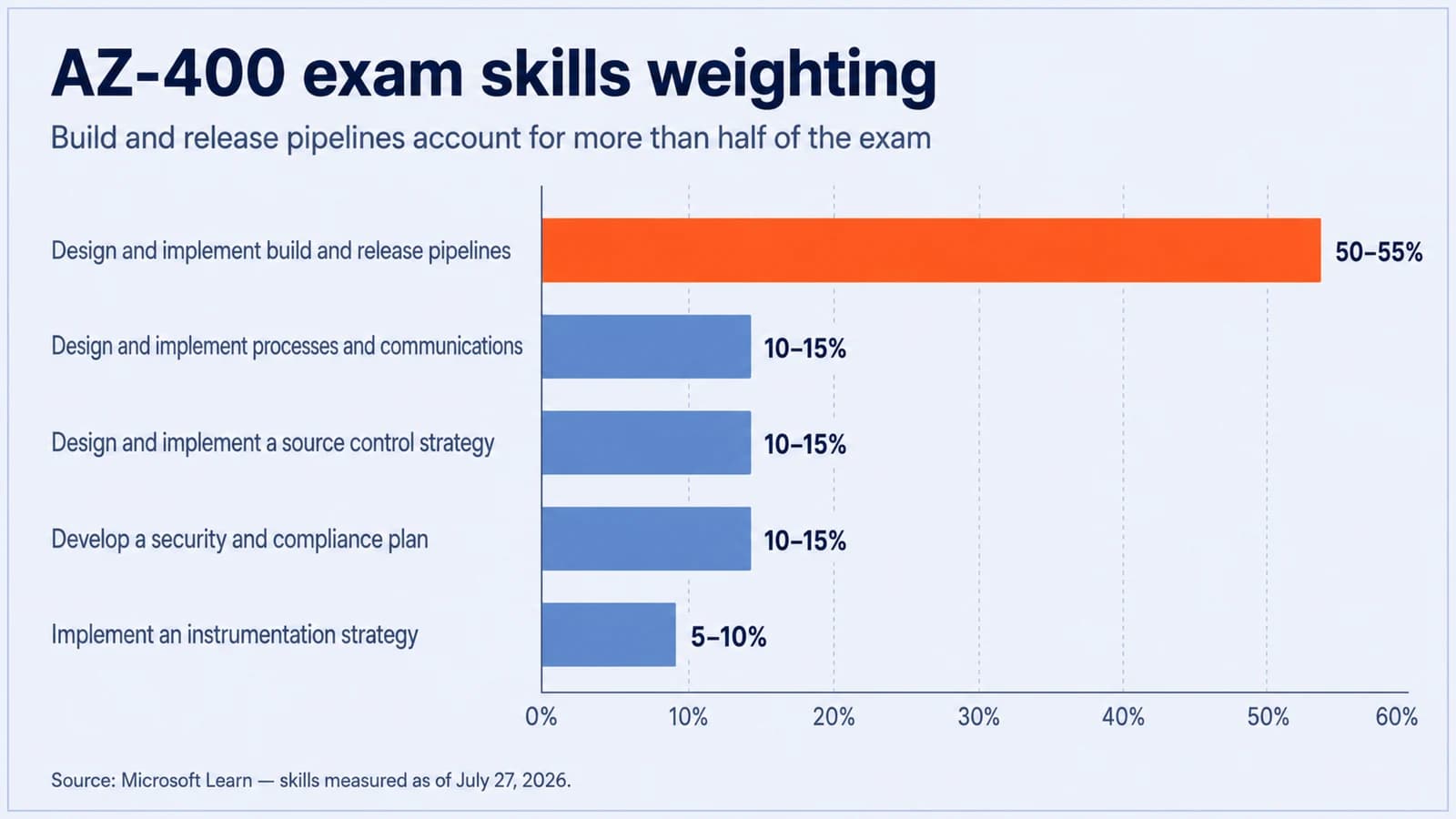
Where the weight actually sits. Curricula imply that all modules matter equally by giving each one a similar-sized box on a web page. The one published, vendor-authored, dated answer to the weighting question comes from Microsoft’s AZ-400 exam. As of the skills-measured version dated July 27, 2026, Microsoft weights the exam as follows:
| AZ-400 skill domain | Weight |
|---|---|
| Design and implement build and release pipelines | 50–55% |
| Design and implement processes and communications | 10–15% |
| Design and implement a source control strategy | 10–15% |
| Develop a security and compliance plan | 10–15% |
| Implement an instrumentation strategy | 5–10% |
Source: Microsoft Learn AZ-400 study guide, skills measured as of July 27, 2026.
Build and release pipelines carry more than half the exam on their own — more than the other four domains combined. Two caveats keep this honest. First, this is an Azure-specific exam, so it says nothing directly about Terraform, Ansible or vendor-neutral Kubernetes. Second, an exam blueprint measures what is assessable, which is not identical to what a job requires. Even with both caveats, it is the only weighting on the table that someone published, dated and staked a certification on — and it points hard at CI/CD.
Foundations: Linux, shell and networking
The Linux module in a DevOps curriculum teaches the filesystem hierarchy, file permissions and ownership, process management, package management, systemd services, SSH and key-based authentication, and enough Bash to write a script with variables, conditionals and loops. Networking basics usually sit here too: IP addressing, ports, DNS resolution, and the difference between a connection refused and a connection timing out.
This module is first because everything after it assumes it. A Dockerfile is a sequence of shell commands. A Kubernetes pod that will not start is diagnosed by reading logs and exec-ing into a container. A CI pipeline that fails is usually failing on a permission, a path or an environment variable. Learners who skip Linux do not fail at Linux later; they fail at Kubernetes, and mistake it for Kubernetes being hard.
Networking is the piece most often underweighted. A large share of real DevOps debugging is a service that cannot reach another service, and that is a DNS, port, firewall or routing question rather than an application question.
What you should be able to do before module two
- Navigate a filesystem, and read and modify permissions with
chmodandchownwithout looking up the octal notation each time. - Find why a service is not running: check the unit status, read its logs, restart it.
- Write a shell script that takes an argument, loops over files, and exits with a meaningful status code.
- Connect to a remote machine over SSH using a key pair, and explain what the key pair does.
- Trace a failed connection: is the process listening, is the port open, does the name resolve.
If a curriculum moves to containers before a learner can do these, the containers module will teach commands rather than understanding.
Version control: Git and collaboration workflows
The Git module covers the local model — commits, branches, merges, rebases, the staging area and what the three trees actually are — and then the collaboration layer: remotes, pull or merge requests, code review, branch protection, and a branching strategy such as trunk-based development or feature branching.
Git precedes CI/CD because a pipeline is triggered by a repository event. Until a learner understands what a commit to a protected branch means, and what a pull request is doing mechanically, a pipeline trigger is a mystery configured by copying someone else’s YAML.
Microsoft weights source control strategy at 10–15% of the AZ-400 exam (skills measured as of July 27, 2026), and the skills listed there are strategic rather than mechanical: designing a branch strategy including trunk-based, feature branch and release branch; implementing pull request workflows through branch policies; managing large files; and recovering or removing specific data from history. That last item is worth flagging, because it is the one most curricula skip and most engineers eventually need — removing a committed secret from Git history is a genuinely different operation from deleting the file, and the naive fix leaves the secret in every clone.
Git is currently at version 2.55.0, though nothing in a DevOps curriculum’s Git module is version-dependent in a way that matters.
Containers: Docker and image fundamentals
The Docker module teaches the distinction between an image and a container, writing Dockerfiles, layer caching and why layer order changes build time, image registries, tagging strategies, volumes for persistent data, container networking, and multi-container local environments with Docker Compose.
Containers precede orchestration for a structural reason: Kubernetes does not build images. It schedules containers that already exist in a registry. A learner who has not built, tagged and pushed an image cannot meaningfully understand what a Kubernetes Deployment is pulling.
The concepts most often left half-taught here are image size and image security. A naive Dockerfile that copies a whole source tree and installs a full toolchain produces an image many times larger than a multi-stage build of the same application, which costs registry storage, pull time on every deployment and attack surface. Multi-stage builds, a minimal base image, and running as a non-root user are the three practices that separate a working Dockerfile from a production one.
Docker’s engine, released as Moby, is at version 29.7.2 as of 28 August 2026. As with Git, the teaching content here does not depend on the specific version.
Orchestration: Kubernetes
The Kubernetes module covers Pods, ReplicaSets and Deployments, Services and how traffic reaches a pod, ConfigMaps and Secrets, namespaces, resource requests and limits, liveness and readiness probes, rolling updates and rollbacks, and usually an Ingress controller for external access. Storage through PersistentVolumes and autoscaling normally appear in some form.
Being direct about the ceiling matters here. Kubernetes is large enough that no course module makes anyone an expert. A well-taught module gets a learner to the point where they can deploy an application, expose it, scale it, diagnose why a pod is in CrashLoopBackOff or ImagePullBackOff, and read the events and logs that explain it. What a module of typical length cannot cover: cluster installation and upgrade from scratch, etcd backup and restore, custom controllers and operators, advanced scheduling with affinity and taints in depth, or the internals of the CNI networking layer. Some of that is CKA territory; some is a job rather than a course.
The trade-off worth naming: most curricula teach Kubernetes on a managed service such as Amazon EKS or Azure Kubernetes Service, or on a local single-node cluster such as minikube or kind. Managed clusters are how most companies actually run Kubernetes, so this is a defensible choice — but it means the control plane is hidden, and the learner never sees the components a self-managed cluster forces you to understand. If you want the layer underneath the module, the Kubernetes architecture guide walks through the control plane and worker node components and traces what happens when you run kubectl apply.
Kubernetes released v1.37.0 on 26 August 2026. A curriculum does not need to track that: Pods, Deployments and Services behave the same across versions, and pinning a patch release in course material only creates staleness. Version currency does matter for one specific decision, though — see the certifications section below, where the exam environment deliberately lags the current release.
Infrastructure as code: Terraform
The Terraform module teaches declarative resource definitions in HCL, providers, the plan and apply cycle, state and why remote state with locking is used on any team, variables and outputs, modules for reuse, and configuration drift — what happens when someone changes a resource in the cloud console and the code no longer matches reality.
State is the concept that carries the module. Terraform’s state file is the mapping between the code and the real resources, and most Terraform incidents are state incidents: two engineers applying at once without locking, a state file lost or committed to Git with credentials inside it, or a resource deleted from the cloud but still in state. A module that teaches terraform apply without teaching what state is has taught a command, not a tool.
Terraform is at version 1.16.0 as of 28 August 2026. The plan/apply model and state semantics taught in a curriculum are stable across the 1.x line.
Infrastructure as code sits after containers and orchestration in most syllabi and before CI/CD, because the thing you provision with Terraform is typically the cluster and supporting infrastructure that the pipeline will deploy into. In dependency terms Terraform and Ansible are better understood as peers — both are automation the pipeline invokes, and both produce the environment Kubernetes runs in, which is how they are drawn in the dependency map above.
Configuration management: Ansible
The Ansible module teaches inventories, playbooks and tasks, modules, roles for structuring reusable automation, variables and templating with Jinja2, and idempotency — the property that running the same playbook twice produces the same result rather than a duplicated change.
The distinction learners most often miss is the one between provisioning and configuration. Terraform creates infrastructure that did not exist: a virtual machine, a network, a load balancer. Ansible configures things that already exist: install these packages, write this config file, restart this service, in this order. They overlap at the edges and each can technically do some of the other’s job, but the division of labour is what makes a toolchain coherent. Ansible is also agentless, connecting over SSH, which is why the Linux and SSH content from module one is a hard prerequisite rather than a soft one.
Two details worth getting right, because they are commonly conflated: the Ansible community package and ansible-core are different artefacts. The community package is at 14.3.1 and ansible-core at 2.21.3 as of 28 August 2026. ansible-core is the engine; the community package bundles it with a large collection of modules.
For the detail underneath this module: Ansible’s architecture and inventory covers how the control node, inventory and connection model fit together, and writing Ansible playbooks covers playbook structure in practice.
CI/CD: the part that carries the most weight
CI/CD is the module that carries the most assessed weight in a DevOps curriculum, and the evidence is Microsoft’s own exam blueprint: build and release pipelines account for 50–55% of the AZ-400 exam (skills measured as of July 27, 2026), more than the other four domains combined.
The module covers pipeline structure — stages, jobs, steps and triggers — build automation, automated testing inside the pipeline, artifact creation and versioning, deployment automation, environment promotion from development through staging to production, approvals and gates, and secrets handling for the credentials a pipeline needs.
Deployment strategies are the substantive part and where curricula vary most. The AZ-400 blueprint names blue-green, canary, ring, progressive exposure, feature flags and A/B testing. These are not interchangeable: blue-green swaps whole environments and needs double the infrastructure during a release; canary routes a fraction of live traffic to a new version and requires monitoring good enough to detect a problem in that fraction; feature flags decouple deployment from release entirely, which is powerful and accumulates its own technical debt when flags are never removed. A curriculum that names all of them and explains none has covered the vocabulary, not the decision.
Most curricula teach either Jenkins or GitHub Actions, and several teach both. Jenkins is self-hosted and plugin-driven, which means the operational load — upgrades, plugin compatibility, agent management — is part of the tool and part of what a course should show you. Jenkins runs two release lines that are commonly confused: the LTS line is at 2.568.2 while the weekly line is at 2.579 as of 28 August 2026. Naming the weekly number as “the Jenkins version” is a frequent error, and installing from the wrong line is a real operational mistake. GitHub Actions is hosted, integrates directly with the repository, and shifts that maintenance burden to GitHub while adding usage-based cost and less control.
The failure mode this module should show you, and the reason it deserves its weighting: a pipeline that is green and deploys broken code is worse than no pipeline, because it manufactures confidence. Test coverage in the pipeline, quality gates, and a rollback path are the parts that make a pipeline trustworthy rather than merely automated.
Cloud platform fundamentals
The cloud module teaches identity and access management, compute (virtual machines and the managed container services), storage classes and their trade-offs, virtual networks and security groups, managed Kubernetes, and cost management. Most Indian providers build this around Amazon Web Services (AWS), some around Microsoft Azure, and some teach both.
Identity and access management deserves more time than it usually gets. Nearly every cloud security incident traces back to over-permissioned credentials, and IAM is also where learners hit their first genuinely confusing abstraction — roles versus users versus policies, and what it means for a machine rather than a person to have an identity. A pipeline that deploys to a cloud needs credentials, and how those credentials are scoped is a design decision the CI/CD module depends on.
The two-cloud trade-off. One of the syllabi read for this article teaches both AWS and Azure inside a single curriculum. Whether that is breadth or dilution depends on total hours. The concepts do transfer — IAM, compute, object storage and virtual networking exist in both, under different names — so a second cloud learned after the first is genuinely faster. The risk is teaching both from zero in the time it takes to learn one properly, producing a learner who can name services in two clouds and configure neither confidently. This is a description of the trade-off, not a rule; a 250-hour curriculum can afford a second cloud in a way a 90-hour one cannot.
Monitoring and observability
The observability module teaches the three signal types — metrics, logs and traces — instrumentation, Prometheus for metrics collection and its query language PromQL, Grafana for dashboards, alerting rules, and service-level objectives. Prometheus is at version 3.14.0 as of 28 August 2026.
The distinction that matters is between monitoring and observability. Monitoring answers questions you knew to ask in advance: is CPU above 80%, is the service returning 500s. Observability is the property of being able to answer questions you did not anticipate, which usually requires higher-cardinality data and distributed tracing. Most course modules teach monitoring well and observability partially, and that is an honest limitation of the format rather than a defect — the observability problems that require tracing tend to appear at a scale a lab environment does not reach.
The DORA correction most syllabi have not made. DORA, a research program run by Google Cloud, currently publishes five metrics, not the four that most course material still teaches:
Throughput
- Change lead time
- Deployment frequency
- Failed deployment recovery time
Instability
- Change fail rate
- Deployment rework rate
Two changes are worth knowing. Failed deployment recovery time replaced mean time to restore (MTTR) — the rename narrows the metric to recovery from failed deployments specifically, rather than recovery from any incident. And deployment rework rate is a fifth metric that the old “four keys” framing does not include at all. Source: dora.dev. If a syllabus or an interviewer refers to “the four key metrics” and MTTR, that is the older framing.
No benchmark figures appear here deliberately. DORA publishes performance-cohort percentages in its annual reports, and I did not open the primary report for this article, so I am not repeating numbers seen second-hand.
Security in the pipeline (DevSecOps)
The security content in a DevOps curriculum covers secrets management, dependency scanning, container image scanning, static analysis in the pipeline, and access control across the toolchain. Microsoft weights security and compliance at 10–15% of the AZ-400 exam (skills measured as of July 27, 2026), and the named skills there are concrete: managing secrets with a key vault, secretless authentication through workload identity federation and OpenID Connect, dependency and secret and licence scanning, and automated container image scanning.
The structural point is that this belongs inside the modules rather than after them. A dependency scan is a pipeline stage. Secrets management is how the CI/CD module gets its credentials. Image scanning is part of the container build. Non-root containers and resource limits are Kubernetes configuration. When security appears as a single late module, it tends to become a vocabulary lesson, because by then every pipeline the learner has built already handles secrets the wrong way.
Secrets are the highest-value item for a learner. Credentials committed to Git, passed as plain environment variables, or baked into an image are among the most common real-world breaches, and the correct handling — a secrets manager, short-lived credentials, and ideally federated identity instead of a long-lived key at all — is teachable inside a lab.
Where AI fits in a modern DevOps curriculum
“AI in DevOps” in a syllabus generally means one of two quite different things, and the phrase alone does not tell you which.
The first is AI-assisted authoring: using a coding assistant to draft pipeline YAML, Dockerfiles, Terraform configurations or shell scripts. This is real and it is now normal practice, but it is a productivity technique layered on top of the tools. It only helps someone who can tell a correct Terraform module from a plausible-looking wrong one, which is why it belongs after the underlying modules and not instead of them.
The second is AIOps: applying models to operational data — anomaly detection on metrics, log clustering to reduce alert noise, correlating signals during an incident, predictive scaling. This is a genuine discipline and depends entirely on the observability module having come first, because it operates on the data that module produces.
The design question worth asking of any syllabus is whether the AI content is integrated into the pipeline modules or appended as a standalone block near the end. One of the syllabi read for this article places its AI module second-to-last, after the cloud modules and before the capstone. A standalone block can still be taught well, but a module positioned at the end of a syllabus is structurally harder to weave into the pipelines the learner already built. The DevOps with AI Masters Program I teach on takes the integrated approach — its AI and AIOps content applies to the DevOps workflows built in the earlier modules rather than sitting as a separate topic.
Labs, projects and how learning is assessed
Labs in a DevOps curriculum fall into three types, and they are not equivalent:
- Guided labs follow explicit steps to a known result. Good for first exposure to a tool’s mechanics; they do not test whether the learner could have arrived there alone.
- Unguided exercises state an objective and no steps. This is where most actual learning happens, because the failures are the content.
- A capstone project builds an end-to-end delivery pipeline as one system.
A realistic DevOps capstone looks like this: an application in a Git repository, a CI pipeline that runs tests and builds a container image on commit, the image pushed to a registry, infrastructure provisioned with Terraform, deployment to a Kubernetes cluster, monitoring attached with dashboards and at least one alert, and secrets handled through a secrets manager rather than environment variables. That single project exercises every one of the nine components, which is why it comes last — it is the assessment that the ordering was learned, not just the tools.
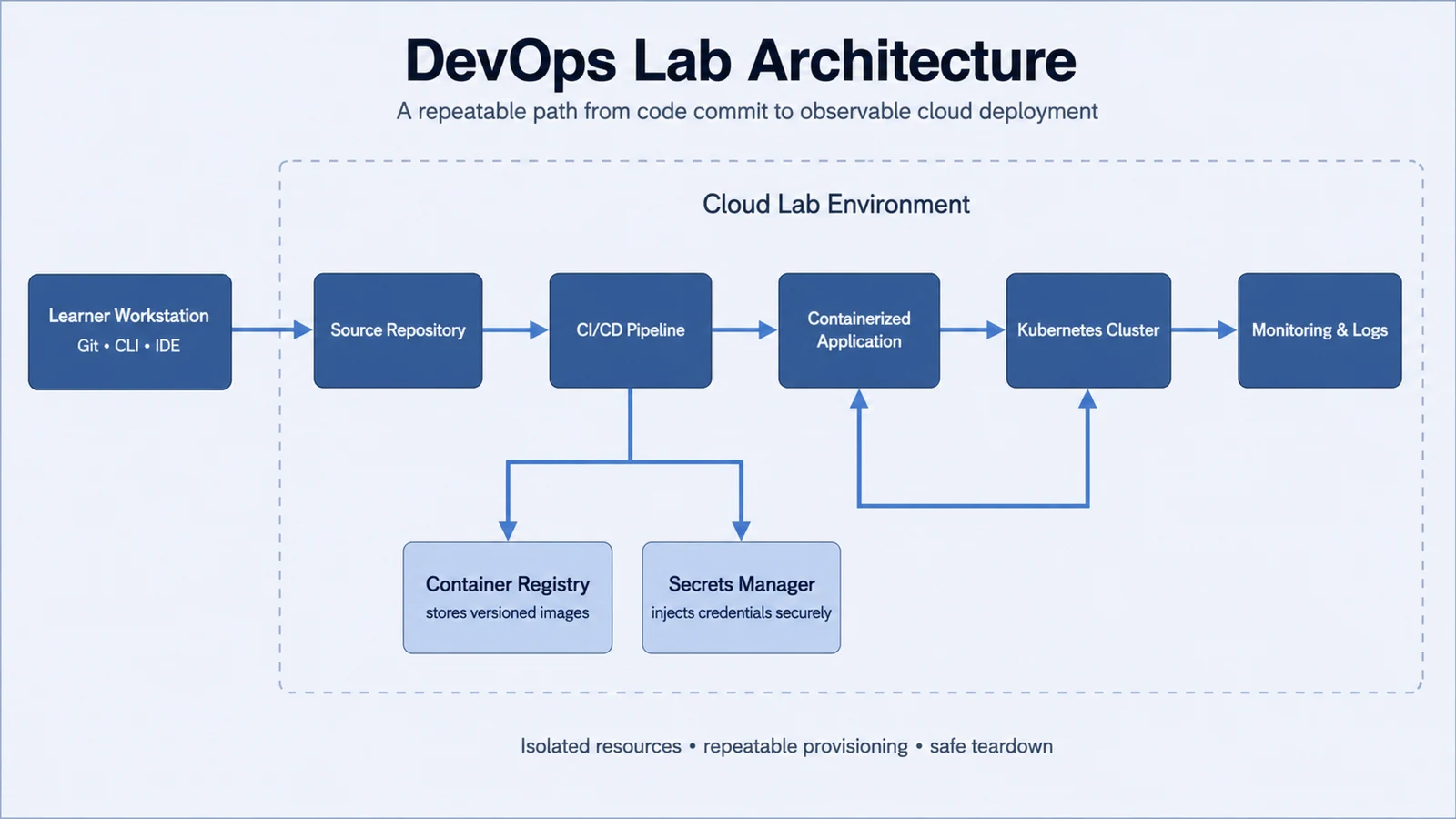
Simulated versus real cloud environments. Curricula differ in whether labs run on a real cloud account or a browser-based simulated environment. The difference is substantive rather than cosmetic. A real cloud account means the learner also encounters IAM permissions that block them, service quotas, region selection, and a bill — all of which are part of the job. A simulated environment removes the friction and the cost, and with them a category of learning. Sandboxes also tend to pre-configure networking and identity, which are precisely the two things that break in production.
Assessment across a good curriculum is usually some mix of lab completion, project review, and in many cases a mock interview or viva. Assessment that consists only of a multiple-choice quiz is measuring recall of a skill set that is almost entirely practical.
Prerequisites: what you genuinely need before starting
The honest entry bar for a DevOps course is comfort on a Linux command line, basic scripting ability, and an understanding of how a web application is structured and deployed. Nothing else is strictly required — and specifically, no degree, no prior DevOps job title, and no advanced programming skill.
That is worth stating plainly because published prerequisites are unreliable in both directions. One commercial syllabus read for this article requires “a completed bachelor’s degree with a minimum of 50% marks”. That is an admissions filter, not a technical prerequisite: it excludes a sysadmin with ten years of hands-on experience and admits a graduate who has never opened a terminal, and it predicts nothing about who will keep up. Another states there are “no formal qualifications or experience-based pre requisite for DevOps” while listing a Python module in month three. Both statements are about enrolment. Neither answers the question the reader is actually asking.
If you meet that entry bar and want to test the subject before paying for anything, our free DevOps course works through the same toolchain in 21 modules. It is the cheapest way to find out whether the work suits you, which is a better use of a first month than choosing between syllabuses you cannot yet evaluate.
What genuinely helps, in rough order of usefulness:
- Command-line comfort. Not expertise — the ability to move around a filesystem, edit a file in a terminal editor, and read an error message without alarm. This is the one that matters.
- Basic scripting. Bash or Python, at the level of variables, loops, conditionals and functions. Every module involves reading someone else’s script.
- How applications are structured. What a web server is, what a database connection is, what a port is, what an environment variable does.
- Version control exposure. Helpful but genuinely taught from scratch in most curricula.
- Networking fundamentals. IP, DNS, ports, HTTP. Frequently the hidden blocker later.
On Python. Most DevOps curricula include some Python, and some include a dedicated module. It is not a prerequisite for entry and it is not the primary DevOps language — Bash covers more day-to-day work, and YAML is the format you will write most. Python matters for automation beyond what shell scripts handle comfortably, for cloud SDKs, and for anything touching the AIOps content.
If none of the five apply to you, the realistic answer is not that a DevOps course is closed to you; it is that the first module will be much harder work than it is for the person beside you, and the honest curricula say so.
How long a DevOps course takes
DevOps course length is set by the delivery format rather than by the syllabus, and the two common Indian formats are a compressed weekday track of roughly three months and an extended weekend track of roughly six months — often covering the identical curriculum. A weekend batch is not a longer course; it is the same course spread across fewer hours per week to fit around a full-time job.
Comparing advertised durations across providers is therefore close to meaningless unless taught hours are stated. Of the two commercial syllabi read in full for this article, one advertises four months with 60+ live hours plus 30+ self-paced hours, and the other advertises five months with 150+ instruction hours plus 100+ assignment hours. One extra advertised month, and well over twice the instruction time. The month figure carries almost no information; the hours figure carries most of it.
I am deliberately not stating an industry-standard duration. Two vendor pages is a sample of two, not a norm, and no source I could verify publishes an authoritative figure for what a DevOps course “typically” runs.
Two conventions also differ and are easy to conflate: Indian providers advertise calendar months, while Microsoft Learn publishes per-module hours for its learning paths. Those are not comparable units.
How much total time it takes to become employable in DevOps is a different question from how long a course runs, and it depends heavily on starting point. If that is what you are weighing, along with the cost and format questions that come with it, how to choose a DevOps course in India covers the buying decision directly.
Certifications a DevOps curriculum prepares you for
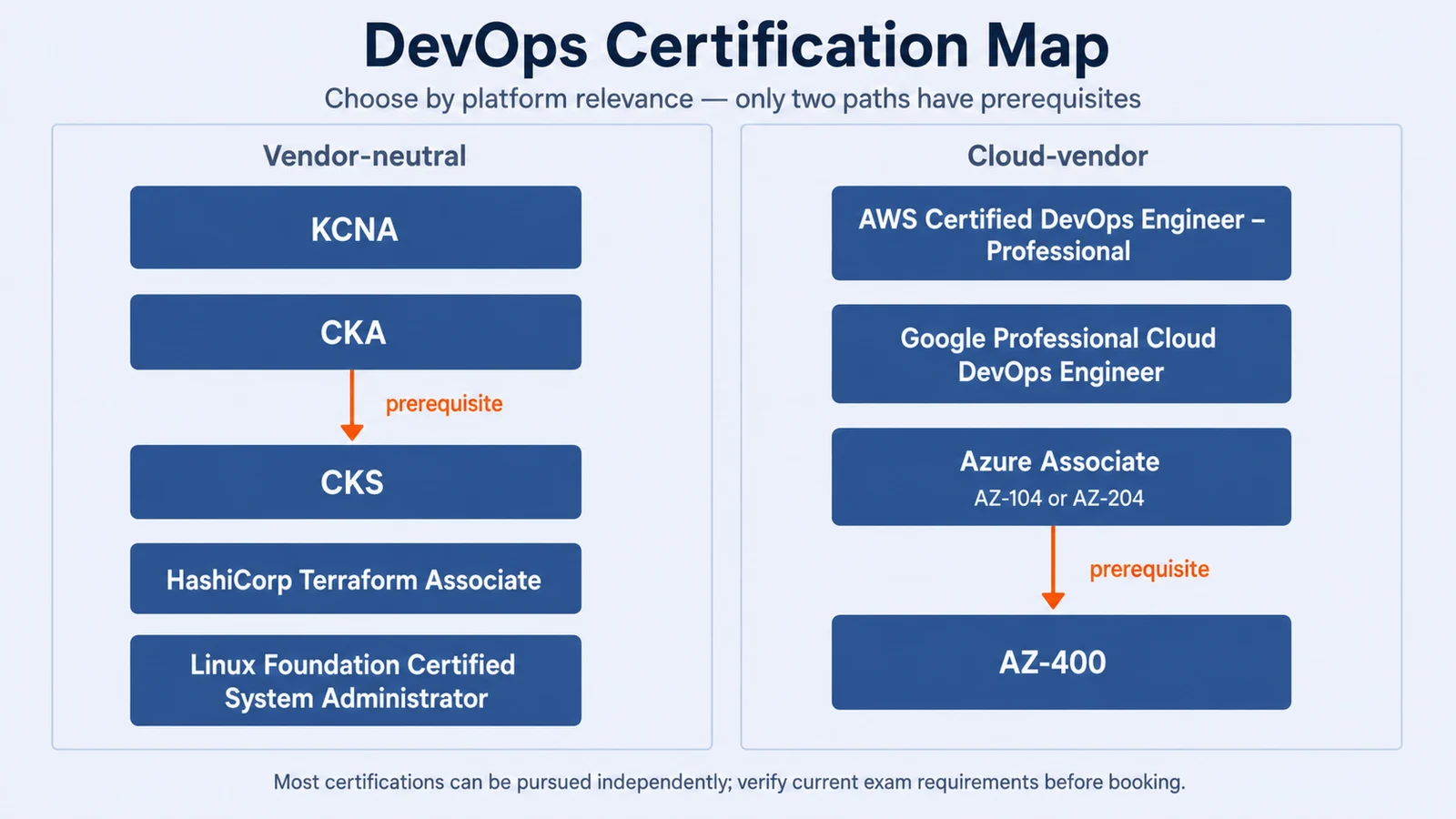
A DevOps curriculum maps to three families of certification: vendor-neutral Kubernetes certifications from the CNCF and The Linux Foundation, cloud-vendor DevOps certifications from Microsoft and AWS, and tool-specific certifications such as HashiCorp’s Terraform Associate. All figures below were verified against the certifying bodies’ own pages on 28 August 2026, and exam fees are quoted in the currency the vendor publishes. Each certification name in the table links to the page its figures were taken from, so you can check any of them — and see whether a vendor has changed a fee or format since this was written.
| Certification | Code | Format | Duration | Fee (USD) | Validity | Prerequisite |
|---|---|---|---|---|---|---|
| Certified Kubernetes Administrator | CKA | Performance-based, command-line | 2 hours | 445, includes one free retake | 2 years | None stated |
| Certified Kubernetes Application Developer | CKAD | Performance-based | — | — | 2 years | None stated |
| Certified Kubernetes Security Specialist | CKS | Performance-based | — | — | 2 years | Must have passed CKA first |
| Microsoft Certified: DevOps Engineer Expert | AZ-400 | Exam, pass mark 700 | — | Region-dependent | Annual renewal, free | Azure Administrator Associate or Azure Developer Associate |
| AWS Certified DevOps Engineer – Professional | DOP-C02 | 75 questions | 180 minutes | 300 | — | 2+ years AWS experience recommended |
| HashiCorp Certified: Terraform Associate | 004 | Exam | 1 hour | 70.50 | 2 years | None stated |
Blank cells are values I could not verify from a primary source and have left empty rather than filled. Fees are the vendors’ published USD prices — several vendors price by region, so converting these to rupees would produce a wrong number rather than a helpful one.
Vendor-neutral: CKA, CKAD, CKS, KCNA
The Kubernetes certifications are administered by the Cloud Native Computing Foundation with The Linux Foundation, which together offer 15 certifications including CKA, CKAD, CKS, KCNA and KCSA. CKA, CKAD and CKS are performance-based: the candidate solves real tasks on a live cluster from a command line under time pressure, rather than answering multiple-choice questions. That format is the reason they carry weight with employers, and the reason a course that only demonstrates Kubernetes rather than making you build in it is poor preparation.
Passing scores are 66% for CKA and CKAD and 67% for CKS. All three are valid for two years, with certifications earned before 1 April 2024 retaining their original three-year validity. CKS has a real prerequisite, and its exact form matters: candidates must have taken and passed the CKA exam prior to attempting CKS — the requirement is on having passed the exam, not on holding a currently active certification.
One currency detail worth planning around: the CKA, CKAD and CKS exam environments currently run Kubernetes v1.35, while the current Kubernetes release is v1.37.0, published on 26 August 2026. The lag is deliberate and the exams are updated quarterly to track releases. Practising against the newest release is fine, but check the exam environment version before booking, because command and API surfaces do shift between versions.
Cloud vendor: AZ-400, DOP-C02
The Microsoft certification is titled Microsoft Certified: DevOps Engineer Expert and requires exam AZ-400. It has a prerequisite that commercial course pages consistently omit: you must already hold either Azure Administrator Associate or Azure Developer Associate. AZ-400 is not a first certification, and any syllabus implying that a beginner finishes the course and sits it is skipping a step. The pass mark is 700, which is a scaled score rather than a percentage — 700 out of 1000 does not mean 70% of questions correct. Microsoft states exam pricing depends on the country or region where the exam is proctored, so no single price applies.
The AWS Certified DevOps Engineer – Professional exam (DOP-C02) is 75 questions in 180 minutes, costs USD 300, and AWS recommends two or more years of experience provisioning and managing AWS environments. It is a professional-level exam and, like AZ-400, is not realistically a course exit exam for someone starting from zero.
Tool-specific: Terraform Associate (004)
HashiCorp Certified: Terraform Associate (004) is a one-hour exam costing USD 70.50, valid for two years, with no stated prerequisite. It is the most accessible certification on this list and maps almost exactly onto what a curriculum’s Terraform module teaches, which makes it a reasonable first certification to attempt during or straight after a course.
What you should be able to do at the end
A DevOps curriculum, completed properly, should leave you able to perform these tasks unaided:
- Administer a Linux server: manage users and permissions, configure and troubleshoot a service, and write shell scripts that automate a repeated task.
- Work in a team Git repository using a defined branching strategy, review a pull request, and resolve a merge conflict without losing work.
- Write a production-shaped Dockerfile — multi-stage, minimal base image, non-root user — build it, tag it, and push it to a registry.
- Deploy an application to Kubernetes with a Deployment and a Service, expose it, scale it, perform a rolling update, roll it back, and diagnose a failing pod from its events and logs.
- Provision cloud infrastructure with Terraform using remote state, read a plan before applying it, and understand what drift means when it appears.
- Write an Ansible playbook that configures a server idempotently.
- Build a CI/CD pipeline that tests, builds, and deploys on commit, with secrets handled through a secrets manager rather than environment variables.
- Instrument an application, collect metrics in Prometheus, build a Grafana dashboard, and configure an alert that fires on a condition you chose deliberately.
- Explain what happened when a deployment fails, using logs, metrics and pipeline output rather than guesswork.
What a course does not make you: someone with production incident experience. The gap between “I built this in a lab” and “I fixed this at 2am while it was costing money” is real, and it is closed by working, not by studying. A curriculum’s job is to make you employable at entry level and able to learn quickly on the job.
Job titles this maps to are typically DevOps Engineer, Cloud Engineer, Platform Engineer, Site Reliability Engineer at junior level, or Build and Release Engineer. Which of those you can credibly apply for depends at least as much on your prior experience as on the course.
Frequently asked questions
What subjects are taught in a DevOps course?
A DevOps course teaches nine core subjects: Linux and shell scripting, Git and version control, Docker containers, Kubernetes orchestration, infrastructure as code with Terraform, configuration management with Ansible, CI/CD pipelines with tools such as Jenkins or GitHub Actions, cloud platform fundamentals on AWS or Azure, and monitoring and observability with Prometheus and Grafana. Security practices and a hands-on capstone project are normally integrated across these subjects.
What are the prerequisites for a DevOps course?
The genuine prerequisites for a DevOps course are comfort on a Linux command line, basic scripting ability in Bash or Python, and an understanding of how a web application is structured and deployed. A degree is not a technical prerequisite, and neither is prior DevOps experience. Some providers state academic entry requirements, but those are admissions filters rather than indicators of whether you can follow the material.
How many modules does a DevOps course have?
DevOps courses typically contain between 8 and 18 modules, depending on how the provider groups the material. Module count on its own is not a quality signal — the same content can be split into 8 modules or 18. A more useful figure is total taught hours divided by module count, which shows how much depth each module can realistically reach.
Does a DevOps course include cloud computing?
Yes. A DevOps course includes cloud platform fundamentals, normally on Amazon Web Services (AWS) or Microsoft Azure, covering identity and access management, compute, storage, virtual networking, managed Kubernetes and cost management. Some curricula teach two cloud platforms; whether that adds breadth or dilutes depth depends on the total instruction hours available.
Is Python required for a DevOps course?
Python is not required to start a DevOps course, though many curricula include a Python module. Bash covers more day-to-day DevOps scripting, and YAML is the format used most often for pipelines and Kubernetes manifests. Python becomes useful for automation beyond shell scripting, for cloud SDKs, and for AIOps content that works with operational data.
Do DevOps courses include hands-on labs, or only demonstrations?
Practices vary, and the distinction is substantive. Labs come in three forms: guided labs that follow steps to a known result, unguided exercises that state only an objective, and an end-to-end capstone project. A further difference is whether labs run on a real cloud account or a simulated sandbox — a real account also exposes IAM permissions, service quotas and cost, which a sandbox typically pre-configures away.
Which certifications does a DevOps curriculum prepare you for?
A DevOps curriculum maps to the Certified Kubernetes Administrator (CKA), Certified Kubernetes Application Developer (CKAD) and Certified Kubernetes Security Specialist (CKS) from the CNCF and The Linux Foundation; Microsoft Certified: DevOps Engineer Expert (exam AZ-400); AWS Certified DevOps Engineer – Professional (DOP-C02); and HashiCorp Certified: Terraform Associate (004). AZ-400 requires an Azure Administrator Associate or Azure Developer Associate certification first, and CKS requires having passed CKA.
Does a DevOps course cover Linux from scratch?
Most DevOps courses do teach Linux from the beginning, covering the filesystem, permissions, processes, package management, systemd services, SSH and shell scripting. Not all do — one 18-module commercial syllabus reviewed for this article contains no Linux module at all. Checking whether a syllabus contains a Linux module is a quick way to test whether it is sequenced for learning or for appearance.
What kind of capstone project does a DevOps course include?
A DevOps capstone project builds one end-to-end delivery pipeline: an application in a Git repository, a CI pipeline that tests and builds a container image on commit, the image pushed to a registry, infrastructure provisioned with Terraform, deployment to a Kubernetes cluster, monitoring and alerting attached, and secrets managed through a secrets manager. The project’s purpose is to exercise every module as one connected system rather than in isolation.
What does "AI in DevOps" mean in a course syllabus?
"AI in DevOps" in a course syllabus usually means one of two things. The first is AI-assisted authoring — using a coding assistant to draft pipeline configuration, Dockerfiles, Terraform code or scripts. The second is AIOps: applying models to operational data for anomaly detection, log clustering, alert-noise reduction and incident correlation. AIOps depends on the observability module having been taught first, because it operates on the metrics and logs that module produces.
Seeing the structure in a real curriculum
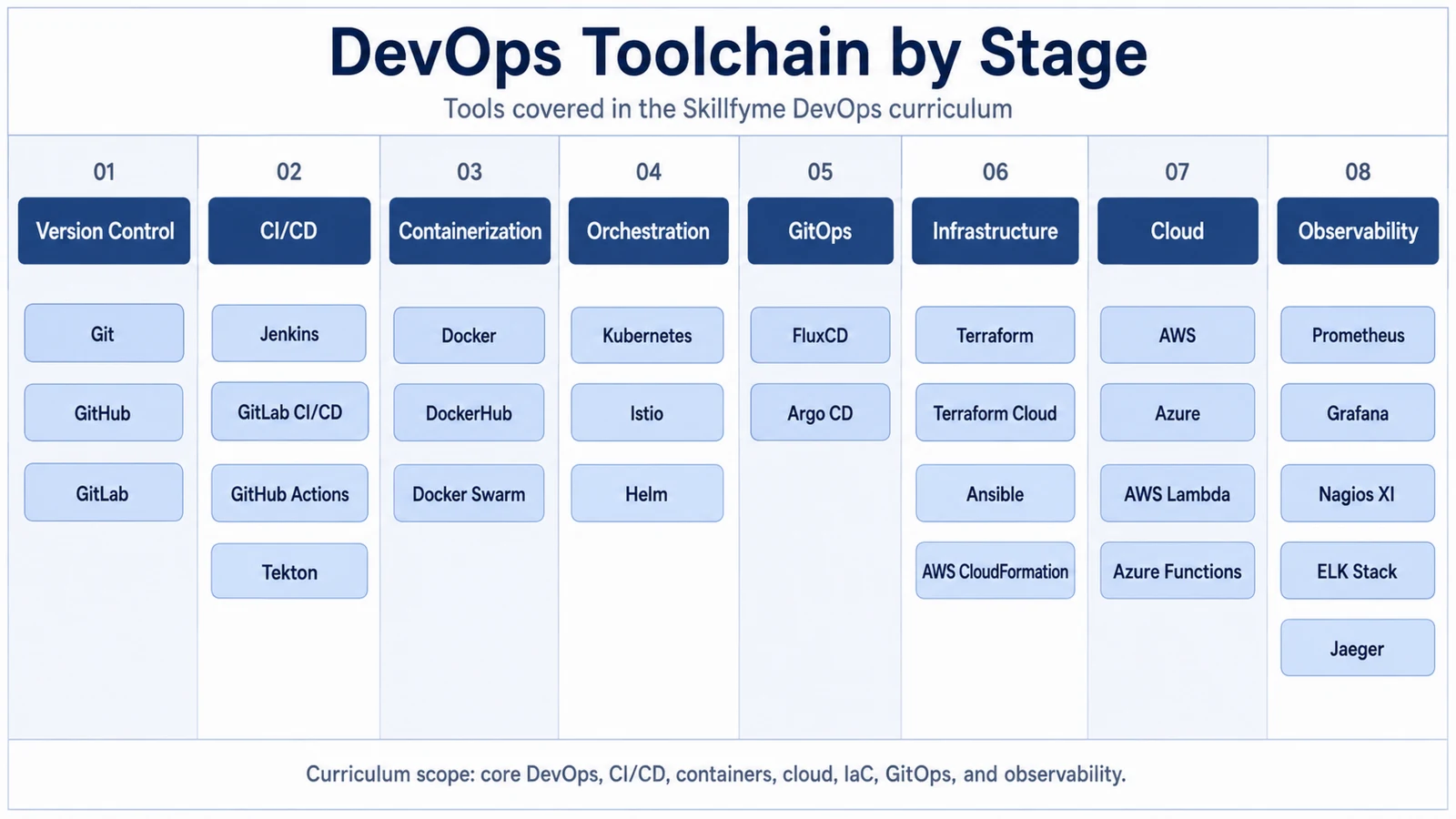
The structure described in this article is not hypothetical. The DevOps with AI Masters Program at Skillfyme is organised into eight modules in dependency order: Linux and Shell Scripting, Git, Docker and Containerisation, Kubernetes Orchestration, Terraform and Infrastructure as Code, CI/CD with Jenkins and GitHub Actions, AWS, and AI and AIOps for DevOps workflows. Linux comes first and AI comes last, applied to the workflows built in the earlier modules rather than taught as a detached topic.
It runs three months in the weekday batch or six months in the weekend batch — the same syllabus at two intensities rather than two different courses, which is how the weekday and weekend formats differ generally. It is delivered live and online across India, includes cloud lab access, and is certified jointly with Vishlesan i-Hub, IIT Patna. Current fees and instalment options are listed on the course page.
If you are comparing several providers rather than looking at one curriculum, the questions worth asking before you pay — live versus pre-recorded classes, real lab access, who issues the certificate, what placement support concretely means, and the true total fee — are covered in how to choose a DevOps course in India.