
DevOps
GPT-6 Astra and the Rise of Agentic DevOps: Can AI Agents Actually Run the Software Delivery Lifecycle?
Agentic DevOps checked against GPT-6 Astra's real benchmarks: what AI agents run autonomously, where humans stay essential, and the skills that hold value.
Agentic DevOps is the use of AI agents that plan, execute and correct work across the software delivery lifecycle, instead of only suggesting code. The capability is real: GPT-6 Astra, released 3 September 2026, scores 72.6% on OSWorld 2.0 computer use and leads Terminal-Bench 4.0 at 57.7. It also trails rival models on coding benchmarks, posts every score at maximum reasoning effort, and ships with a confirmation policy that pauses it for human approval before consequential actions. Agents run steps. Nobody has shown they run pipelines.
What GPT-6 Astra can actually do in a pipeline
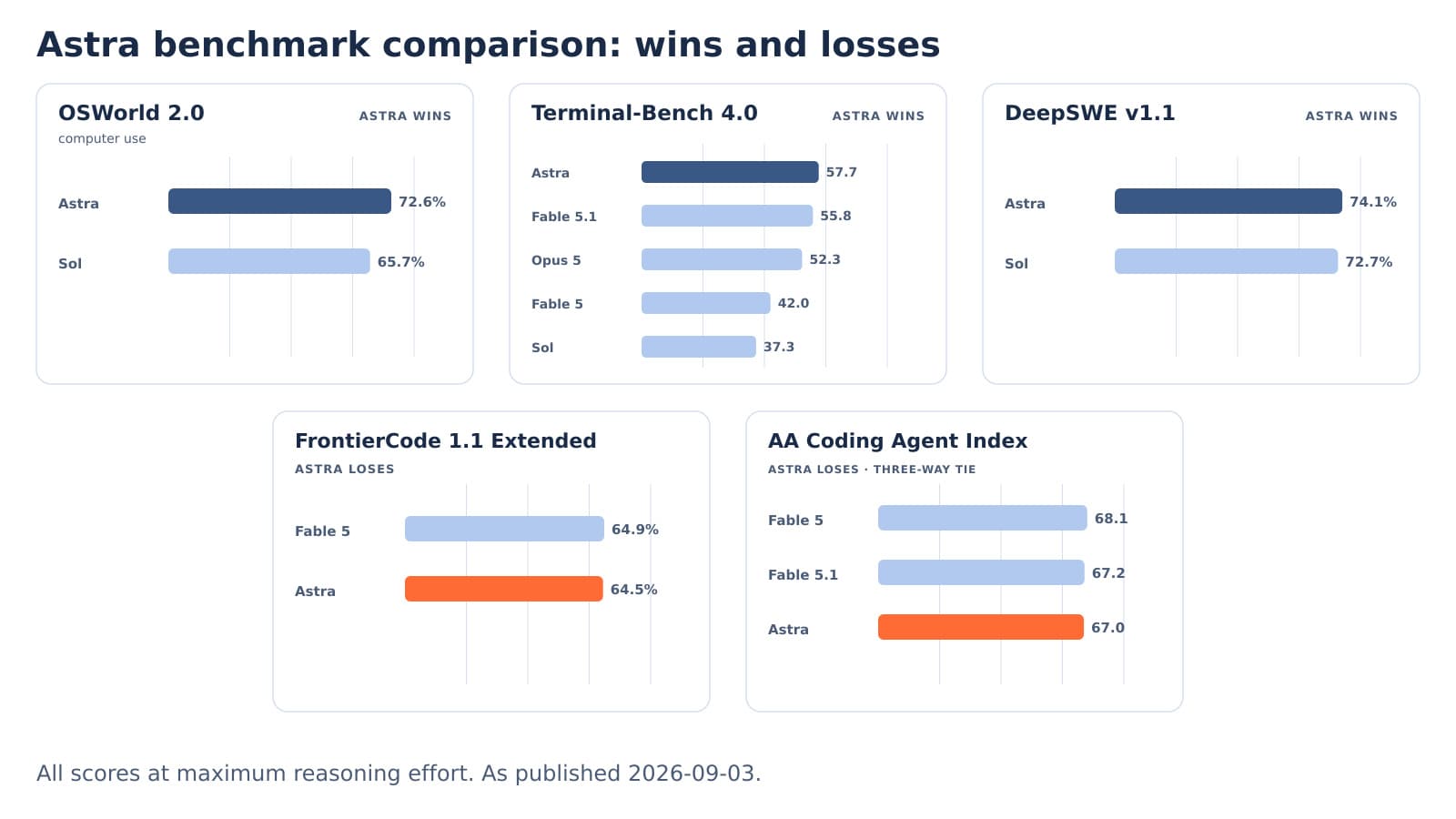
OpenAI released GPT-6 Astra on 3 September 2026 with the model ID gpt-6-astra, per OpenAI’s model documentation. Two of its published numbers matter to anyone running a delivery pipeline. The first is computer use. On OSWorld 2.0 Astra scores 72.6%, against 65.7% for its predecessor GPT-5.6 Sol, and finishes tasks in roughly 47% less time. The second is terminal work: 57.7 on Terminal-Bench 4.0, ahead of Fable 5.1 at 55.8, Opus 5 at 52.3, Fable 5 at 42.0 and Sol at 37.3. A model driving a shell competently is the precondition for everything else here. The API backs it with a hosted shell, apply-patch, computer use and MCP, so the mechanical ability to clone a repo, edit files, run tests and read the output is there.
Astra does not sweep coding. On FrontierCode 1.1 Extended it scores 64.5% against Fable 5’s 64.9%. On the Artificial Analysis Coding Agent Index it lands at 67.0, behind Fable 5.1 at 67.2 and Fable 5 at 68.1 — a spread narrow enough to call a three-way tie. Its DeepSWE v1.1 score of 74.1% beats Sol’s 72.7% by 1.4 points, again inside the range where rival models cluster. Astra is first or joint-first at driving a machine, and merely competitive at writing the code. Every one of those numbers was produced at maximum reasoning effort, which lifts scores while inflating latency and token cost.
The thing worth sitting with: no published benchmark measures running a production delivery pipeline. OSWorld tests desktop tasks, Terminal-Bench tests terminal tasks, DeepSWE tests issue resolution. Your pipeline has flaky integration tests, a staging environment that drifts from production, secrets you cannot expose, and a change-approval process with a human’s name on it. Every number above is a proxy, and the gap between proxy and job is where the interesting failures live.
Where a human is still required — by design
The strongest argument against full pipeline autonomy sits in OpenAI’s own deployment documentation, not in sceptical engineering blogs.
Astra ships with a confirmation policy that, in OpenAI’s words, “tells the model when it must pause and obtain the user’s approval, for example before sending certain communications or making purchases.” That is an approval gate compiled into the product, not a best practice a cautious platform team layered on top.
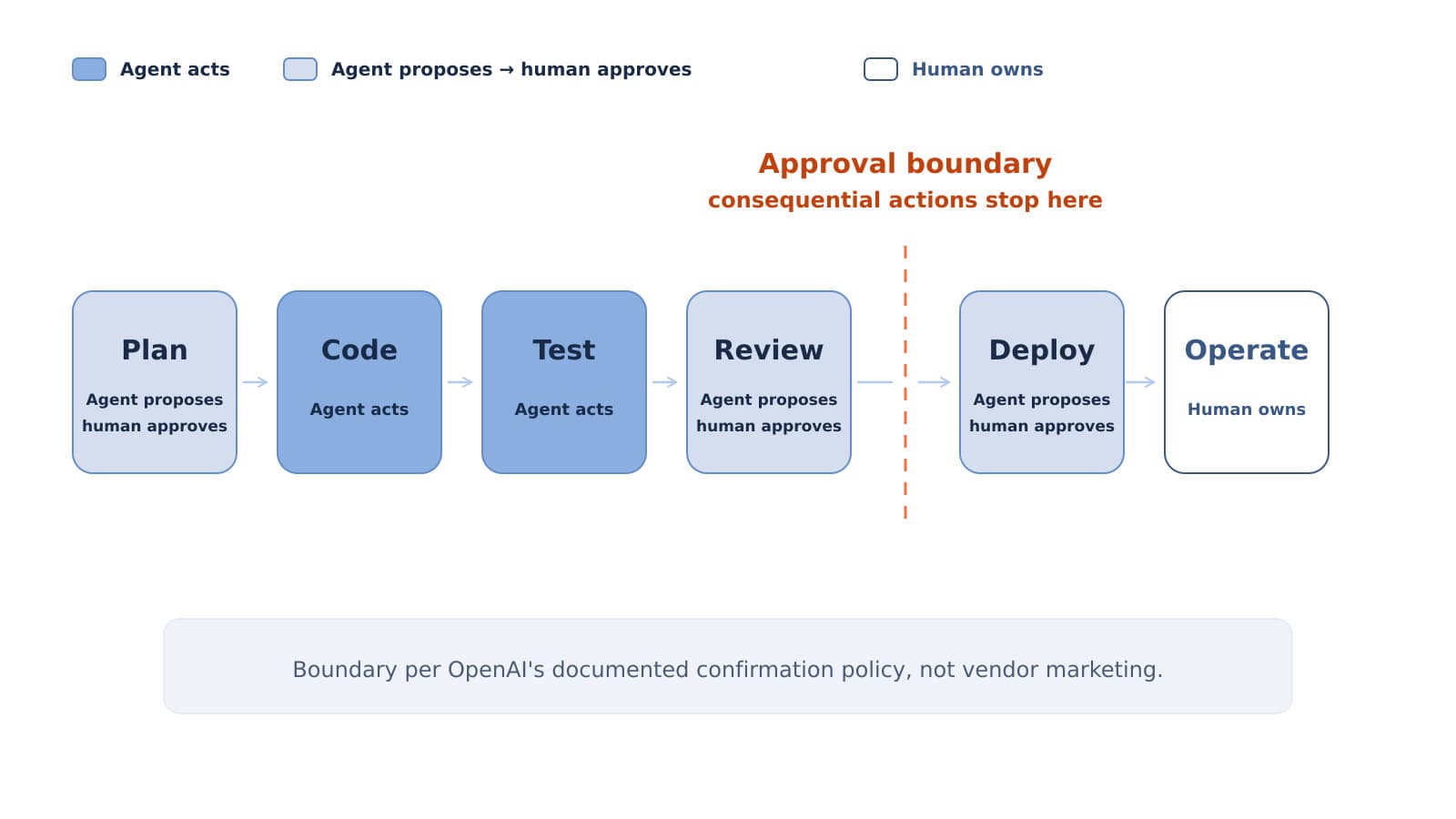
OpenAI applied “an initial period of restricted deployment before broader internal availability of Astra models as coding agents” — the vendor throttled its own engineers first. And its safeguards “apply to all tool-using inference with Astra models, and include security measures and universal monitoring for misalignment that pages humans who can stop workloads as appropriate.”
The detail that should change how you instrument things: OpenAI states Astra “has lower CoT monitorability than GPT-5.6 Sol across most CoT token lengths.” The model got better at the work and harder to watch while doing it. If you were counting on reading an agent’s reasoning trace to understand a bad deploy, that plan is weaker on the newer model than the older one.
So what does “running DevOps” mean now?
Put the vendor narrative next to the survey data and the gap is hard to miss.
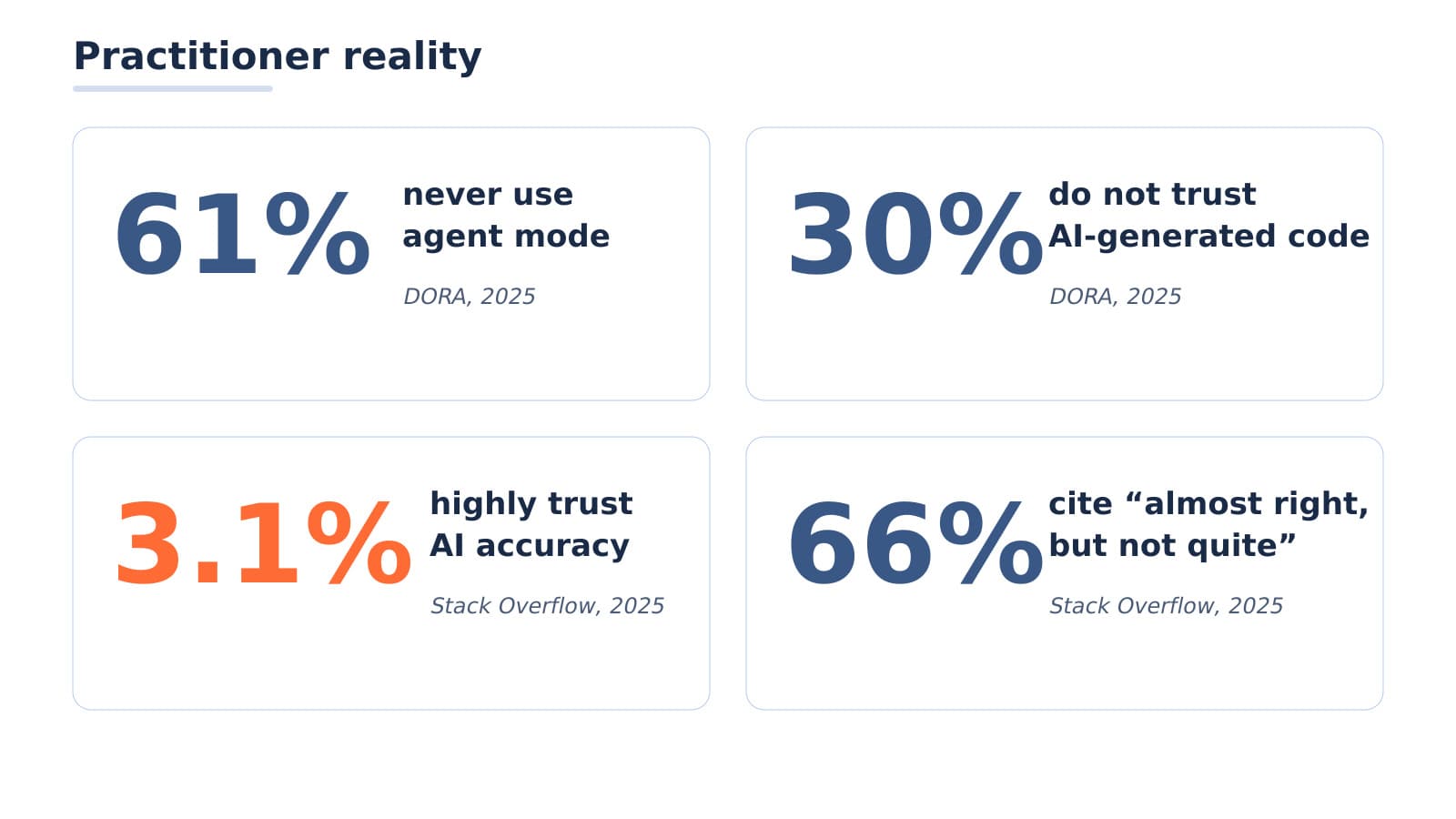
DORA’s 2025 report, drawing on roughly 5,000 responses, found 90% of respondents use AI somewhere in software development. On agent mode — AI making changes autonomously — 61% never use it, and 17% use it once a day or more. Stack Overflow’s 2025 survey of over 49,000 developers found 84% use or plan to use AI tools, while only 3.1% highly trust the accuracy of what comes back. The top frustration, at 66%, is “solutions that are almost right, but not quite,” and 45.2% say debugging AI-generated code takes longer than writing it themselves.
That last pair is the operational reality. Almost-right code is the expensive kind. It passes review by looking finished.
DORA’s central finding frames the rest: AI is an amplifier, increasing the strength of high-performing organisations and worsening the dysfunction of those that struggle. An agent pointed at a pipeline with weak tests and no rollback path does not fix either. It executes against both, faster.
Microsoft put the term “agentic DevOps” into circulation in May 2025, and even its launch framing keeps the developer “conducting agents, and approving recommendations,” with “every proposed change reviewed before it ships.” The company selling the vision still puts a person at the gate.
So the job does not disappear. It moves up a layer. You stop being the person who runs the steps and become the person who defines what the system may do without asking, and who answers for it when it does. That is harder than the job it replaces. What AI does to your telemetry is a separate question — our piece on AIOps in DevOps covers the operations side, where models read production rather than change it. For the layer underneath both, our walk through what AI changes in each DevOps pillar shows how far the shift reaches beyond the pipeline itself.
The skills that stay valuable
Six, all pipeline-specific. Generic advice about writing better prompts is covered elsewhere and is not what protects you here.
- Blast-radius design. Which credentials an agent holds, which environments it can reach, what it may touch without review. Put this first: it caps the damage every other failure on this list can do.
- Approval-gate architecture. Knowing where a confirmation policy attaches in a real CI/CD flow. Gate the merge, the migration and the production apply — not the linting.
- Rollback and recovery. Agent failure is probabilistic, not deterministic. The same input can produce a good change on Tuesday and a bad one on Thursday, so recovery has to be routine rather than heroic.
- Review at volume. The 66% “almost right” problem is a review problem. Once agents open pull requests faster than people read them, review throughput becomes the constraint on the whole system.
- Agent observability and audit trails. Given the documented monitorability regression, capturing what the agent did — commands, diffs, approvals — is now your instrumentation job, not the model’s.
- Cost and effort governance. Maximum reasoning effort is what produces benchmark scores and what produces surprising invoices. Knowing which tasks deserve it is an engineering decision with a budget attached.
Frequently asked questions
What is agentic DevOps?
Agentic DevOps is the practice of letting AI agents carry out multi-step work across the software delivery lifecycle — planning a change, editing code, running tests, preparing a deploy — rather than only autocompleting code in an editor. The distinguishing feature is the control loop: the agent observes the result of its own action and decides the next one. What it does not include is unsupervised authority over production, which current frontier models gate behind human approval by design.
Can AI agents actually deploy to production on their own?
Technically they can perform the individual steps: a model like GPT-6 Astra has hosted shell access, can apply patches, and scores 72.6% on OSWorld 2.0 computer-use tasks. In practice this is rare and gated. OpenAI ships Astra with a confirmation policy requiring the model to pause for user approval before consequential actions, and DORA’s 2025 survey found 61% of respondents never use autonomous agent mode at all. No verified public case study shows a frontier model owning a production deploy end to end without human approval.
Is agentic DevOps the same as AIOps?
No. AIOps applies models to operational telemetry — anomaly detection on metrics, log clustering, incident correlation — and reads what production is doing. Agentic DevOps applies agents to the delivery pipeline and changes what ships. One watches the system, the other modifies it, and they fail in different ways: a wrong AIOps signal wastes an on-call engineer’s night, while a wrong agentic change reaches users.
Will AI agents replace DevOps engineers?
The evidence points to role change rather than replacement. DORA’s 2025 report found 61% of engineers never use agent mode and 30% do not trust AI-generated code, while Stack Overflow’s 2025 survey found only 3.1% highly trust AI accuracy. DORA’s 2026 ROI report explicitly discourages using AI adoption as a reason to cut headcount. An agent can open a pull request or roll back a deploy, but it cannot carry the consequence — someone still decides what the system may do unsupervised and answers for it when it goes wrong.
What should a DevOps engineer learn first for agentic AI?
Blast-radius design first: which credentials an agent holds, which environments it can reach, and what it may change without review. Approval-gate architecture second — knowing where a confirmation step belongs in a real CI/CD flow, typically at merge, migration and production apply rather than at linting. Both are ordinary systems engineering pointed at a non-deterministic component, which is ground experienced DevOps engineers already stand on.
Does the Skillfyme DevOps with AI programme cover this?
The DevOps with AI Masters Program builds AI and agent content into the pipeline modules rather than appending it as a standalone block, so guardrails, approval gates and rollback design apply to workflows you have already built. It runs three months on the weekday batch or six on the weekend batch, live and instructor-led, with joint certification from Vishlesan i-Hub, IIT Patna.
Full module list, batch dates and certification details are on the AI DevOps course page.
Next steps
Take one deploy your team performs regularly and write down three answers: what an agent could do unsupervised, what it must ask before doing, and how fast you could undo it. That document is the actual artefact of agentic DevOps. Everything else is tooling that will turn over.