
DevOps
DevOps with AI vs Plain DevOps: Is the Upgrade Worth It?
What a DevOps with AI course adds to plain DevOps skills, when to upgrade now or wait, and what the evidence says about salary, openings and role security.
A DevOps with AI course doesn’t replace the skills you use to run pipelines, clusters and on-call rotations. It adds a layer on top. AI drafts infrastructure code for you to review, models flag unusual behaviour in telemetry that fixed thresholds can miss, and you design the guardrails for automation that acts on its own.
For a working DevOps engineer in India in 2026, whether to add AI skills now is conditional. Upgrade now if AI tooling is reaching your team, your next role asks for AI skills, or your scope has stalled. If none applies, waiting is defensible, for up to a year while you close observability or infrastructure-as-code (IaC) gaps, or with no fixed deadline if your foundations are solid. Be wary of anyone promising a specific salary jump; we found no published source that measures one.
What DevOps with AI adds to a plain DevOps skillset
DevOps with AI keeps the traditional DevOps toolchain and changes how you write configuration, read operational data and decide what automation may do without a human.
| Work area | Plain DevOps | What the AI layer adds | What stays your job |
|---|---|---|---|
| Pipeline and IaC code | Hand-written Jenkinsfiles and Terraform | An assistant drafts it; you review the diff | Knowing what a correct plan looks like |
| CI/CD reliability | Retries, manual flaky-test triage | Failure and flaky-test prediction from build history | Deciding which stages are safe to skip |
| Monitoring | Static thresholds in Prometheus and Grafana | Anomaly detection and alert grouping | Instrumentation quality |
| Incident response | Runbooks, manual search in the ELK Stack | A first hypothesis from logs, metrics and deploys | Calling root cause and rollback |
| Remediation | Rule-based autoscaling, scripted restarts | Bounded automatic rollbacks and restarts | Blast radius, permissions, audit trail |
| Pipeline security | Scanners and policy gates | AI-assisted threat detection | Owning the response |
Instrumentation, rollback calls and blast radius are already a DevOps engineer’s job, which makes the AI upgrade shorter for you than for a beginner.
The new skill is judging output that looks right and isn’t. Picture a generated Terraform module that passes terraform validate and still opens a security group to 0.0.0.0/0. Or an anomaly alert firing every Monday at 9 a.m. because the model never learned your weekly traffic pattern. Catching bad AI output takes fundamentals and a habit of distrust.
AIOps in DevOps covers how AIOps (AI for IT operations) models behave on live telemetry and why rollouts stall.
Should you upgrade now or wait a year or two?
Learning AI skills now or waiting depends on how far AI tooling has reached your DevOps team and how solid your observability and infrastructure-as-code foundations are.
In Stack Overflow’s 2025 Developer Survey (over 49,000 responses, fielded May 29 to June 23, 2025), 84% of respondents said they use or plan to use AI tools in development, and 51% of professional developers use them daily. The same survey found AI agents “not yet mainstream”, with 52% of developers not using agents or sticking to simpler AI tools. Respondents were self-selected developers worldwide, which makes this a directional signal for Indian teams.
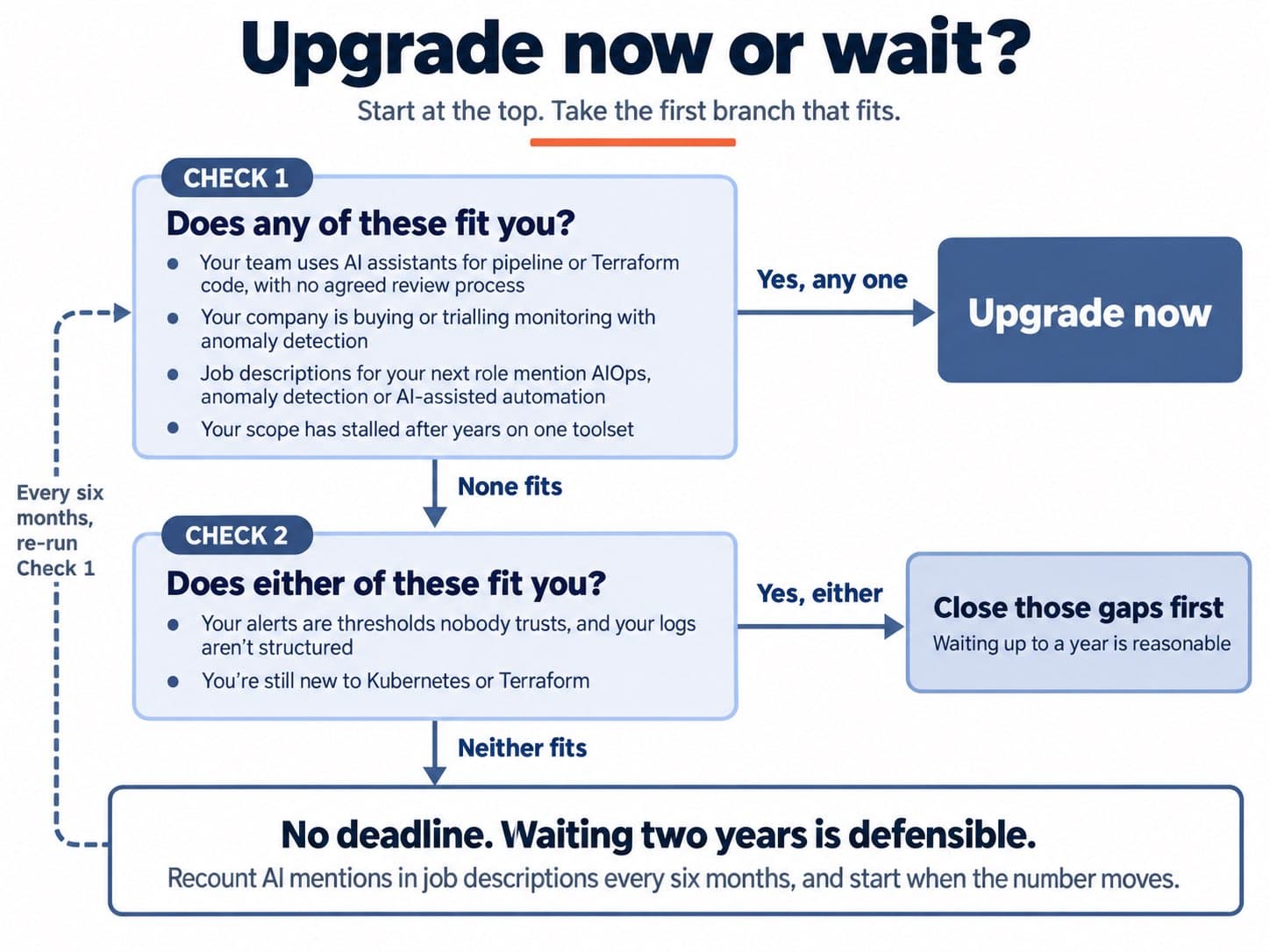
Upgrade now if any of these is true:
- Your team uses AI assistants for pipeline or Terraform code, and nobody has agreed how that output gets reviewed.
- Your company is buying or trialling monitoring with anomaly detection.
- Job descriptions for your next role mention AIOps, anomaly detection or AI-assisted automation.
- Your scope has stalled after years on one toolset.
Waiting up to a year is reasonable if:
- Your alerts are thresholds nobody trusts and your logs aren’t structured. Fix that first; AIOps needs that groundwork.
- You’re still new to Kubernetes or Terraform. You can’t review generated code for a tool you can’t write by hand.
If nothing on either list fits, because AI hasn’t reached your team but your foundations are solid, there’s no deadline. Waiting two years is defensible. Recount AI mentions in job descriptions every six months and start when the number moves.
Our view, if an upgrade-now condition fits you: start this quarter, because whoever sets up a team’s AI guardrails usually ends up owning them. That holds even if you’re still new to Kubernetes or Terraform. Write the configuration by hand first, then review what an assistant drafts.
If you’re in the upgrade-now group, the DevOps with AI Masters Program page lists the modules, and you can download the curriculum there after a short form.
What is the ROI of adding AI skills to DevOps?
The return on adding AI skills to a DevOps background is clearer in role scope and role security than in salary, because we found no reliable published figure that isolates an “AI premium” for DevOps engineers in India.
Salary
Any claimed AI premium for DevOps salaries, whether a percentage or lakhs, needs a disclosed sample and method. Published DevOps salary data for India also varies sharply by sample, which the DevOps career roadmap explains with two sources side by side.
What you can take into a pay conversation is scope: owning an AIOps rollout or reviewing AI-generated infrastructure changes is a bigger job than maintaining pipelines.
Job openings
There’s no verified count of “DevOps with AI” job openings in India. A Deloitte–NASSCOM report published in August 2024 projected Indian AI talent demand to grow from 600,000–650,000 to more than 1,250,000 during 2022–27. It covers AI roles broadly and predates 2026 by two years.
Your own sample tells you more. Open 20 job descriptions for the role you’d apply to next and count how many ask for AIOps, anomaly detection, AI-assisted automation or LLM tooling. As a rough rule of thumb, two of 20 makes AI skills a differentiator, and twelve makes them close to a requirement.
Role security
Role security in DevOps comes from owning the calls automation can’t be trusted to make alone, like deciding what an agent may touch or answering for an automated rollback that goes wrong.
AI tooling tends to absorb repetitive work first, so an engineer whose week is mostly boilerplate configuration and first-pass log search is more exposed; one who designs the approval gates and rollback paths is harder to replace. Agentic DevOps maps where a human is still required when agents run parts of delivery.
Is a DevOps with AI course the right route for you?
Full disclosure: Skillfyme publishes this article and runs the DevOps with AI Masters Program, which teaches the AI layer on top of the full DevOps toolchain. The AI module covers AI-driven automation, predictive analytics, incident root cause analysis, AI-enhanced monitoring, security, and self-healing systems. Two of its advanced capstones are a CI/CD pipeline that predicts failures and flaky tests from build history and a self-healing platform on AWS EKS where Python-based anomaly detection triggers automated recovery.
The program runs 3 months on weekday evenings or 6 months on weekends, with over 200 hours of live instructor-led sessions either way. The fee is ₹45,000 (list price ₹64,000), and certification is issued jointly with Vishlesan i-Hub, IIT Patna.
The program starts with Linux and Git, which the course FAQ says operations people usually move through faster. If your fundamentals are solid and you only want the AI layer, self-study with a sandbox project can get you far. A course earns its fee when you want mentor-reviewed capstones and a fixed schedule alongside a full-time job. Before paying anyone, read how to choose the best DevOps course in India.
Frequently asked questions
Do I need machine learning to learn DevOps with AI?
No. DevOps with AI is applied work: reviewing AI-generated configuration, tuning anomaly detection against your own metrics, and setting limits on automated actions. You need enough understanding of how a model behaves on operational data to know when to distrust it, for example why a detector starts raising false positives after a traffic pattern changes. Training models from scratch is a separate specialisation. Basic Python is worth having; Skillfyme’s self-healing capstone uses it for anomaly detection.
How do I know when AI skills matter for my next DevOps role?
When job descriptions start asking for AI skills. Open 20 postings for the DevOps role you’d apply to next and count how many mention AIOps (AI for IT operations), anomaly detection, AI-assisted automation or LLM tooling. As a rough rule of thumb, two of 20 makes AI skills a differentiator; twelve makes them close to a requirement.
Is DevOps with AI the same as MLOps?
No. MLOps is the practice of deploying, monitoring and retraining machine learning models as production systems. DevOps with AI applies AI to DevOps work itself, such as predicting build failures or detecting anomalies in infrastructure metrics. The two share tooling like CI/CD pipelines and Kubernetes, but training and feature pipelines are MLOps territory, and Skillfyme’s DevOps with AI curriculum does not list MLOps as a module.
Can I learn DevOps with AI on my own instead of taking a course?
Yes, if your DevOps fundamentals are solid. Pick one real problem, such as flaky tests in your CI pipeline or an alert your team ignores, collect its history, and test whether an AI approach beats your current retry rule or threshold. Self-study rarely includes anyone checking whether your guardrails would hold under a bad automated action. That review, plus a fixed schedule, is what a structured course adds.
How long does Skillfyme’s DevOps with AI course take?
Skillfyme’s DevOps with AI Masters Program runs 3 months in the weekday batch or 6 months in the weekend batch, with over 200 hours of live instructor-led sessions in both.