
DevOps
DevOps Engineer Career Roadmap: Skills, Salary, and Certifications That Actually Matter
Which DevOps skills and certifications actually matter in 2026, why India salary data disagrees by 2.3x, and how AI changed the role. Career-stage roadmap.
Most DevOps career roadmaps are a tool list with arrows drawn between the logos. Learn Linux, then Docker, then Kubernetes, then Terraform, then you are a DevOps engineer. That describes a syllabus, not a career. It does not tell you what changes between an engineer at the bottom of the pay range and one at the top of it, and it does not tell you which certificates on your LinkedIn a hiring manager actually reads.
This DevOps career roadmap for 2026 answers the three things worth knowing before you commit the next 6–18 months: what the progression really looks like, which credentials carry weight, and how AI has changed the job description.
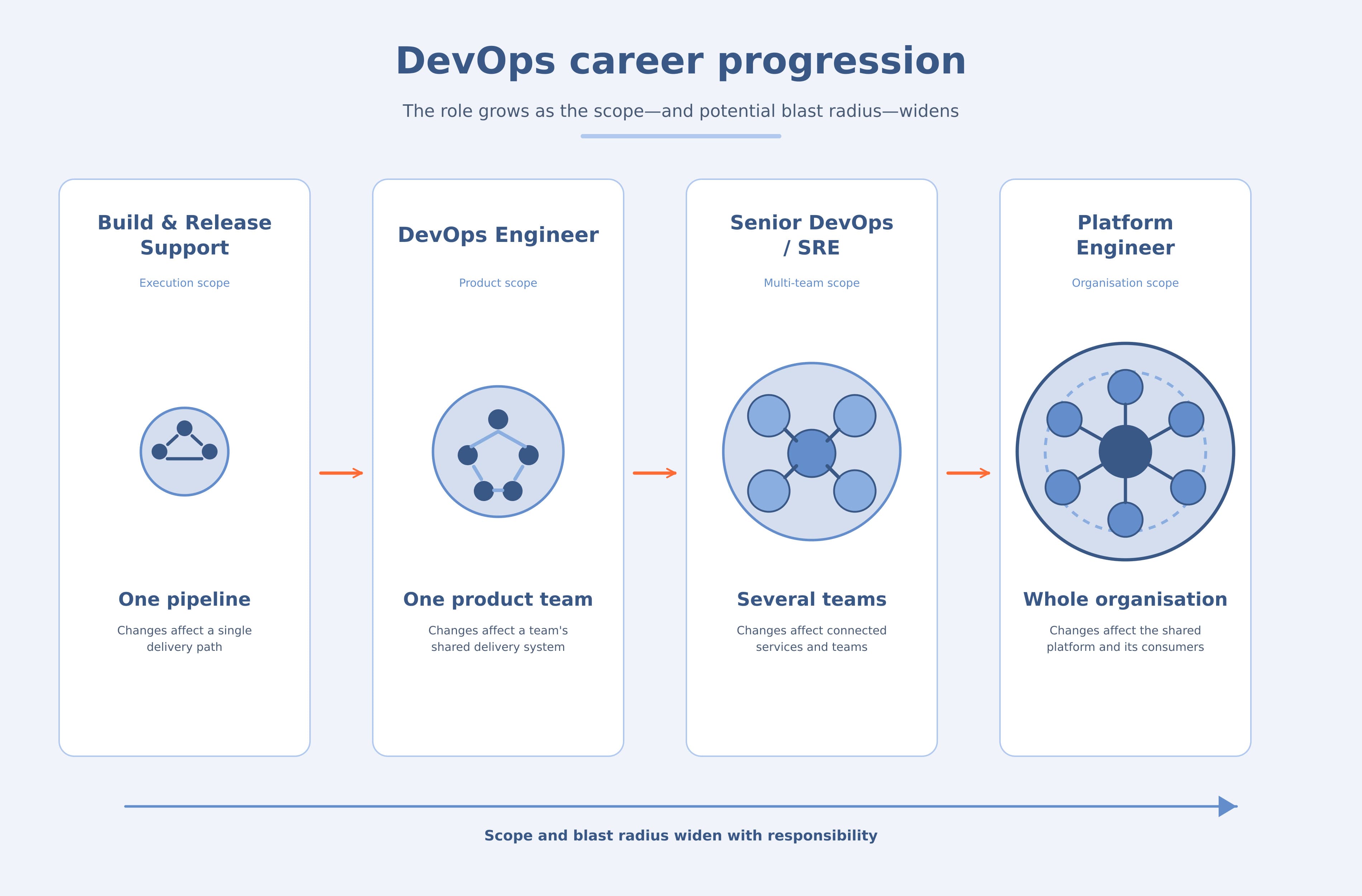
What a realistic DevOps career path looks like in India
DevOps progression is measured by the size of the blast radius you are trusted with, not by years served. Four stages describe it:
- Build and release support (0–2 years in the role). You run pipelines someone else designed. You fix failed builds, manage artifacts, handle access requests. Your decisions affect one pipeline.
- DevOps engineer (roughly 2–5 years). You own the pipeline itself and the infrastructure code behind it. You write the Terraform, you debug why the deployment hangs at the readiness probe, you get paged. Your decisions affect one product team.
- Senior DevOps / SRE (roughly 5–8 years). You own reliability targets and the architecture that meets them. You are deciding whether a service should be rewritten or given more headroom, and defending that call in a design review. Your decisions affect several teams.
- Platform engineer / DevOps architect (8+ years). You build the paved road other engineers deploy on — the internal platform, the standards, the golden paths. Your decisions affect everyone who ships.
The move most people get stuck on is stage 2 to stage 3, and adding another tool to your CV will not unstick it. What changes is ownership: you become the person who decides what the system should do, then answers for it when it does not.
What DevOps salary data actually says — and why the numbers disagree
Published India DevOps salary figures are unreliable, and knowing why is more useful than memorising a band.
As of 13 September 2026, Levels.fyi lists a median total compensation of ₹18,30,327 for DevOps Engineer in India, from voluntary self-reported submissions. Indeed’s India career page for the same role reports an average base salary of ₹7,92,182, stated as drawn from 311 salaries in job postings over the preceding 36 months, last updated 4 September 2026.
That is a 2.3x gap for the same job title, in the same country, in the same month. Neither source is lying — they measure different populations:
- Levels.fyi skews heavily toward product companies and global capability centres, and counts total compensation including stock and bonus. People who submit are disproportionately those with a number worth submitting.
- Indeed draws from advertised base pay across a much wider employer mix, including services and staffing firms, where advertised ranges sit lower and equity is rare.
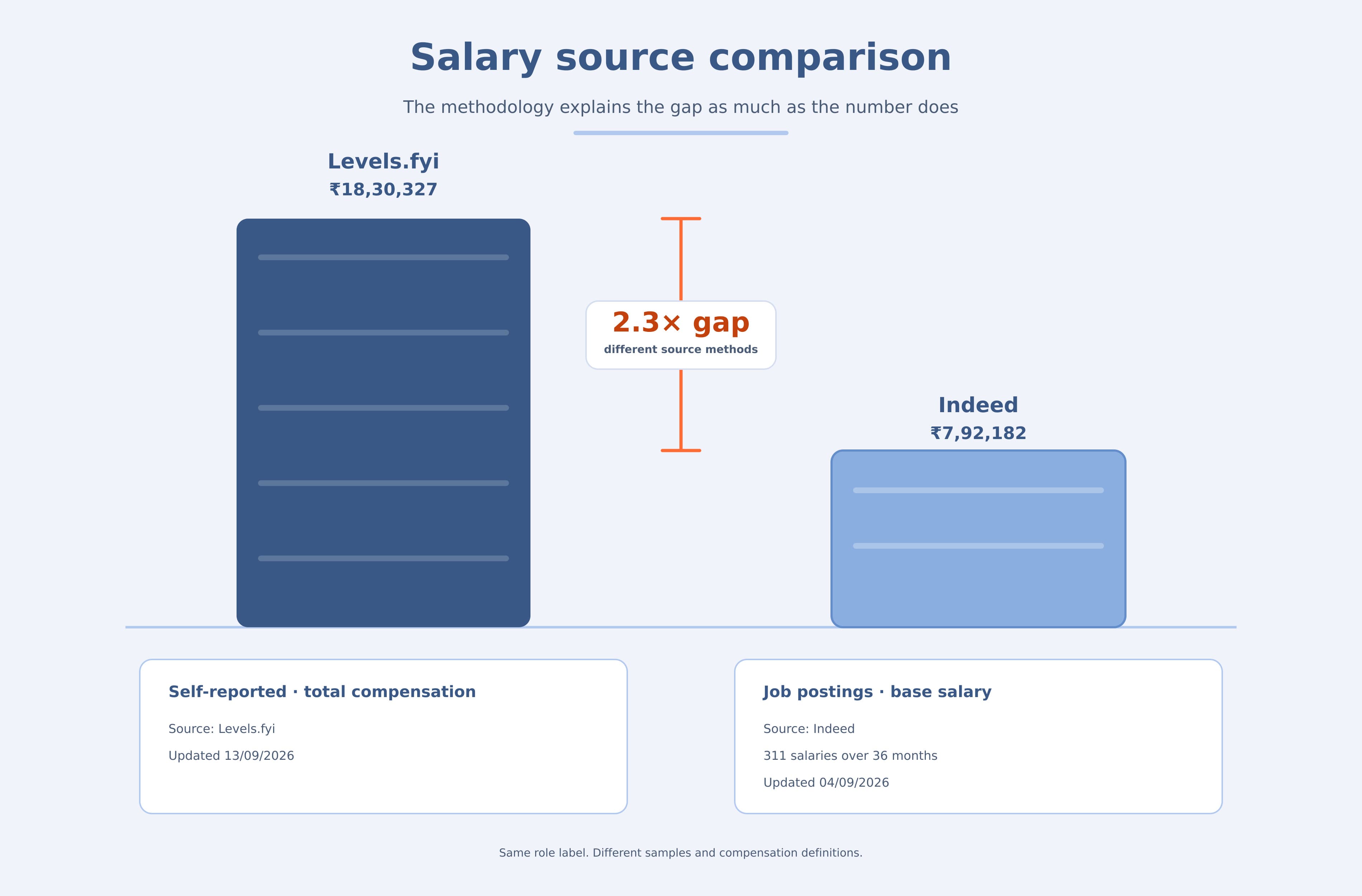
The practical read: your compensation is set less by the title and more by which of those two populations employs you, and whether your pay is base-only or includes equity. An engineer moving from a services firm to a product company frequently sees a larger jump from that single move than from three years of incremental appraisals.
Which DevOps certifications carry weight, and which are resume noise
A certification does one job in hiring: it gives a stranger reading your CV a reason to believe you can do something before they have spoken to you. It is a filtering signal, not a salary lever. Judge each one by what it actually proves.
Certifications that demonstrate something
| Certification | Issuer | Why it signals | Validity |
|---|---|---|---|
| Certified Kubernetes Administrator (CKA) | CNCF / Linux Foundation | Performance-based: a 2-hour proctored exam solved from a command line against real clusters. You cannot pass it by recognising answers. | 2 years |
| Certified Kubernetes Security Specialist (CKS) | CNCF / Linux Foundation | Also hands-on, and gated — you must have passed CKA first. The prerequisite means it cannot be a first certificate. | 2 years |
| AWS Certified DevOps Engineer – Professional (DOP-C02) | AWS | Professional tier, 75 questions in 180 minutes, scenario-based rather than recall-based. | 3 years |
| HashiCorp Certified: Terraform Associate (004) | HashiCorp | Narrow and current — the 004 version tests Terraform 1.12 and HCP Terraform. | 2 years |
What is closer to resume noise
- Any multiple-choice foundational or “essentials” badge in a tool you already use daily. It proves vocabulary, not capability, and a senior interviewer will read it as padding.
- An expired credential listed without its date. Every certification above expires. Listing a lapsed CKA undated reads as either carelessness or concealment, and both are worse than omitting it.
- A certification in a version that no longer exists. Terraform Associate 003 has been replaced by 004. Listing 003 in 2026 tells a reviewer your knowledge has a timestamp on it.
- Volume. Six certificates across six unrelated tools reads as someone collecting credentials instead of going deep on one stack.
One caution on causation: claims that a specific certification produces a specific salary increase are not something published data supports. A certification opens the interview. What you say in the interview sets the number.
If you are weighing a structured programme against self-study, how to choose a DevOps course in India covers that decision, and what a DevOps course actually includes breaks down the modules.
How AI changes what “DevOps skills” means
Google Cloud’s 2025 DORA report, State of AI-Assisted Software Development, published 24 September 2025 from nearly 5,000 technology professionals worldwide, found 90% using AI at work — while 30% reported little or no trust in AI-generated code. The 2025 Stack Overflow Developer Survey found the same tension at larger scale: 84% of respondents use or plan to use AI tools, yet only 3.1% said they highly trust the accuracy of the output, against 45.7% expressing some level of distrust.
High adoption with low trust is the whole story for your learning plan. Generating a Terraform module or a Helm chart has become cheap. Being the person who can tell whether the generated module will survive a production incident has not. DORA’s central finding is that AI amplifies an organisation’s existing strengths and weaknesses rather than fixing them — which means it also amplifies yours.
So the priority shift is: less time on syntax memorisation, more on the things that let you review output critically — system design, failure modes, cost, security boundaries, and knowing what “good” looks like in your own environment. For how AI agents actually operate inside a pipeline, AIOps in DevOps and agentic DevOps go into the mechanics. For the broader engineering picture, see AI skills for software engineers.
Where to start, depending on where you are
- Coming from sysadmin or support: the gap is usually version control and infrastructure as code, not Linux. Start with Git workflows and Terraform.
- Coming from development: the gap is operational — observability, on-call reasoning, networking. Kubernetes is the fastest way to hit all three — start with how Kubernetes architecture works.
- Already a DevOps engineer and stalled: the gap is scope, not tools. Take ownership of something with a reliability target attached.
Whichever of those you are, an interview or an appraisal will ask you to talk about the practice rather than the tooling. Our breakdown of the principles DevOps is actually built on sorts out the pillars, the 7 C’s and the lifecycle phases that get used interchangeably in those conversations, and says where AI has changed each one.
Frequently asked questions
How long does it take to become a DevOps engineer from an IT support or sysadmin role?
Most people making this move already have the Linux and networking foundation. The gap is version control and infrastructure as code, which is a 6–18 month effort alongside a full-time job. The transition is faster from sysadmin than from a non-technical role because the operational instinct is already there.
Is CKA worth it in 2026?
CKA is a 2-hour performance-based exam solved from a command line against live clusters, issued by CNCF and the Linux Foundation, and valid for two years. Because it cannot be passed by recognising multiple-choice answers, it functions as a credible capability signal. It is also the prerequisite for CKS.
Which DevOps certification should I take first?
CKA, if your work involves Kubernetes, because it is hands-on and it unlocks CKS later. If your environment is AWS-centric, AWS Certified DevOps Engineer – Professional (DOP-C02) is the professional-tier equivalent. Avoid starting with a foundational multiple-choice badge in a tool you already use daily.
Will AI replace DevOps engineers?
The observable shift in published survey data is toward judgement rather than replacement. Google Cloud’s 2025 DORA report found 90% of nearly 5,000 technology professionals use AI at work while 30% report little or no trust in AI-generated code. High adoption with low trust means reviewing and validating output is now the scarce skill.
Why do DevOps salary figures for India vary so much?
Sources measure different populations. As of September 2026, Levels.fyi lists a median total compensation of ₹18,30,327 from self-reported submissions skewed toward product companies, while Indeed reports an average base salary of ₹7,92,182 from 311 job postings across a wider employer mix. Total compensation versus advertised base pay explains most of the gap.
Plan your next move
If you would rather read first, our guide to choosing a DevOps course in India covers the questions worth sending to any provider before you pay, and the DevOps masters program page sets out the modules, batch timings and project work in full.